
Lab Coat Manufacturer in Bangladesh for Hospital, Laboratory and Healthcare Buyers
Siatex is a lab coat manufacturer in Bangladesh producing coats for hospital groups, laboratory operators and healthcare wholesalers. Every order is built around your cloth choice, fit block and size chart, never a ready design, so the approved coat is your own.
Buyers assembling a complete clinical wardrobe often order the coat alongside our nurse uniform manufacturer range, graded on one shared chart. Ours is a family-run business: a single merchandising team stays with your order from first sample to last sealed carton, packing each coat as approved.
Lab Coat Fabrics: Poly-Cotton Twill, Poplin and Buyer-Specified Cloth
Fabric decides how the coat wears through a working week, so every programme starts with cloth selection. Poly-cotton twill gives a smooth surface that launders well, while poplin runs lighter for wards and laboratories, and blend and weight follow your specification.
Core fabric stories include:
- Poly-cotton twill, smooth firm weave
- Poly-cotton poplin, lighter hand
- Cotton-rich twill for premium ranges
- Polyester-rich blends for industrial laundering
- Pure cotton poplin where specified
- Buyer-specified anti-static finish
- Buyer-specified fluid-resistant finish
- Buyer colours for coded departments
- Other buyer-specified fabrics and finishes
Buyers building a clinical workwear range compare cloth with our medical scrubs manufacturer programme before fixing the fabric range. Approving cloth first protects shade and hand feel, since white shows every dye-lot difference.
Custom Lab Coat Sizes, Fits and Size Ranges for France and Netherlands Buyers
Accurate sizing decides whether a coat is worn all day, so each coat is graded to your chart. French buyers often run a closer unisex fit with longer body lengths for laboratory staff, graded from a detailed measurement set.
Netherlands programmes split the range: a shaped ladies fit for clinic teams beside a straighter unisex fit for laboratory and pharmacy staff, both held to one chart. Fit samples are measured against your chart before cutting, covering chest, body length and sleeve, so every size matches the approved base.
Lab Coat Construction: Collars, Fronts and Pockets
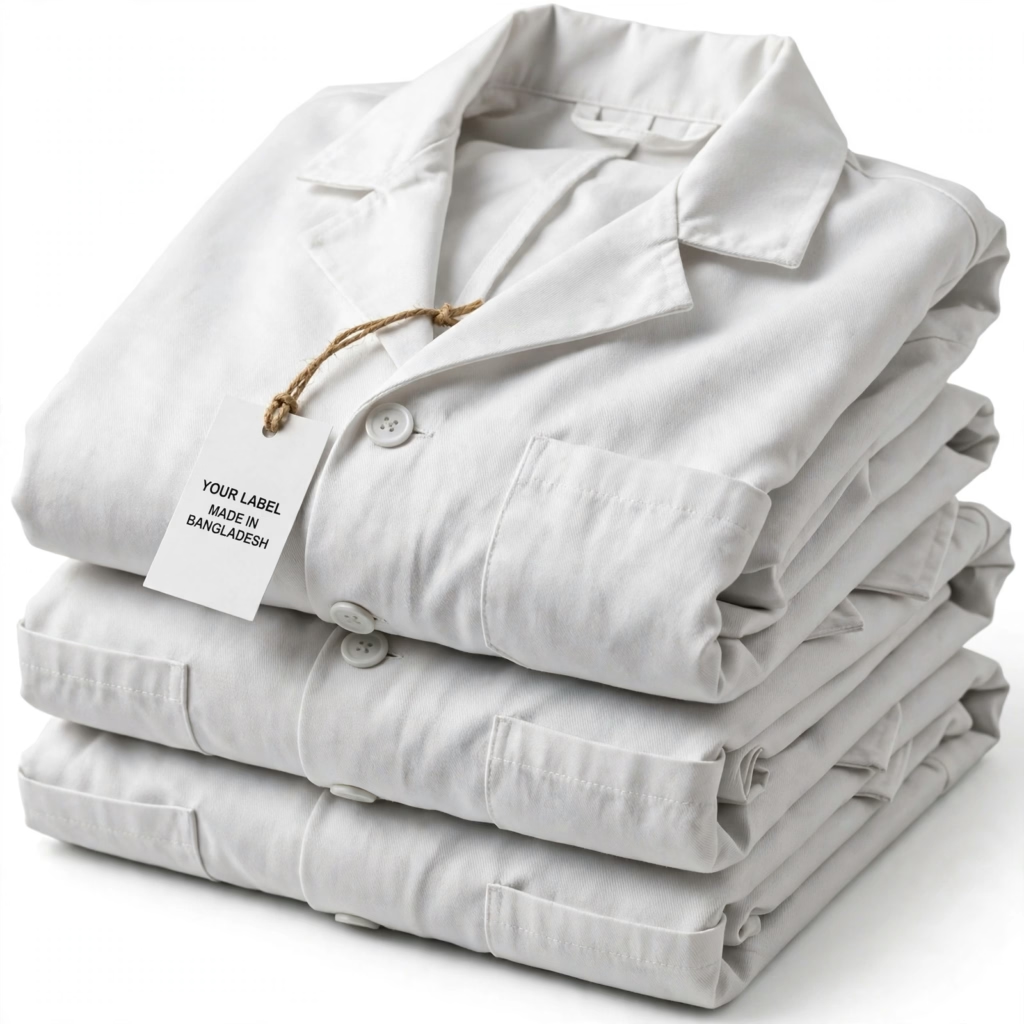
Construction decides whether a coat survives daily wear and industrial washing, and the collar sets the standard. Notched lapels are cut to lie flat and hold their edge, while fronts close with buttons or snap studs to your specification.
Construction details that define the build:
- Notched lapel collar, flat lying
- Button front or snap-stud front
- Three patch pockets: one chest, two lower
- Back vent for ease of movement
- Side access slits at the pockets
- Optional knit cuffs at the sleeve
These details are fixed at the pre-production sample, so every coat in the order carries the finish your buyers approved.
Clean Finishing and Tidy Seams on Every Lab Coat
White cloth shows every fault, so finishing discipline carries the garment: seams are worked flat and even, pocket corners are bar-tacked against the strain of instruments and notebooks, and hems are levelled so the coat hangs straight.
The same discipline shapes our chef uniform manufacturer programme, where white coats are finished to the same standard. Buyers read finishing quality at the collar and pocket edges first, because those are the points a coat is judged on.
Customisation: Embroidery, Labels and Trims for Your Lab Coat
Customisation turns a coat into your own product rather than a shared design. Embroidered names and logos are placed to your artwork, and woven labels, size labels and hangtags carry your branding.
The options buyers combine most often:
- Embroidered name and logo placement
- Button or snap-stud front choice
- Knit cuff or plain cuff finish
- Pocket layout to your pattern
- Woven labels and hangtags in your branding
- Department colours matched to swatches
Buyers extending a uniform range add embroidered pieces from our security guard uniform manufacturer programme, while in France labels keep the coat plain and compete on embroidery, label and packaging.
Private Label Lab Coat Production Under Your Own Label
We produce solely under buyers’ own brands, so a finished coat carries your label only. Woven labels, care labels, hangtags and packaging are made from your artwork files, and our name appears nowhere on the coat, the polybag or the carton.
Repeat orders reuse your approved label and trim set, so the last coat matches the first sample approved, season after season. Your buyers see a consistent brand story from first carton to replenishment.
Lab Coat Sampling and Product Development Built Around Your Specification
Sampling turns your brief into a coat you can hold before bulk commitment. Buyers begin with cloth and fit approval on the actual garment, because a white coat reads differently on the rail than in a photograph, and one sample settles it.
Fit comments, collar corrections, pocket placement and embroidery positions are worked through at sampling stage, and once you approve the pre-production sample, it becomes the standard every coat is measured against. Cloth and trim choices are recorded against that sample, so bulk production starts from an agreed reference.
Quality Control on Every Lab Coat Order
Quality is protected by checking rather than hoping, because our merchandising and quality team follows each order from fabric inspection to packing. White cloth is checked for shade evenness and marks, the two faults a plain coat can hide.
The checkpoints every order passes:
- Fabric inspection before cutting begins
- Shade checks across every dye lot
- Stitch security and seam strength checks
- Pocket, button and stud attachment checks
- Measurement checks against your size chart
- Final count and packing accuracy check
Faulty pieces are corrected or remade before cartons are sealed. Your customers receive a coat that matches the standard, keeping complaint and return rates low.
Production Follow-Up and Communication on Every Coat Order
One merchandiser tracks your coat order from confirmation to dispatch and reports each stage as it is reached. News comes at sample approval, cutting, sewing, finishing and packing, and questions are answered as they arrive, never left hanging.
That communication rests on 37 years of supplying workwear programmes to buyers planning ranges around delivery dates. If a cloth or embroidery decision needs your input, you hear with options attached, so your launch calendar stays protected.
Packaging and Shipping Your Lab Coat Orders From Bangladesh
Finished coats are folded and packed to your instruction, as singles in polybags or in department sets, with hangtags and carton markings to your requirements. Contents are counted and packing checked before every carton is sealed.
From Chattogram port, consignments sail to the USA, the UK, Germany, Canada and Australia, paperwork drawn up to suit your import rules. Programmes serve the Netherlands, where buyers supply hospitals and laboratories across northern Europe. Dispatch news follows each sailing, so your coats land press-ready in the week your range goes on sale.
How to Start Your Lab Coat Order
Starting is simple: send your tech pack or a brief covering cloth, sizes and the markets you sell into, and we reply with fabric options and a sampling route. Facilities buyers review our mens safety coverall manufacturer programme before fixing specification.
Approval of the sample releases production through cutting, sewing, finishing and packing, under your control at each sign-off point. Nothing is made ahead of your confirmed order. It opens with a clear brief and closes with a coat range buyers come back for.
White Coat Programmes That Buyers in France and Netherlands Build Healthcare Ranges Around
Healthcare ranges are where the white coat earns its keep, and French and Dutch buyers build those ranges differently. French laboratory groups often run one unisex coat across every department, graded close with longer body lengths, so staff read as one team from reception to research bench. Embroidery, pocket layout and cloth are agreed once, then held across both programmes.
Netherlands buyers tend to split the programme: shaped ladies coats for clinic teams beside straighter unisex coats for laboratory and pharmacy staff, both graded from one chart. Cloth, embroidery and label sets are held constant across repeat orders, so a mid-year replenishment matches the first delivery coat for coat.
Fit and Sizing Notes for USA and UK Coat Programmes
The classic coat fit is clean and easy through the body, and American and British buyers grade that ease differently. Programmes for the USA usually carry a fuller chest and a longer body length that sits well over scrubs, while UK programmes often grade a little closer, with chest sizes leading the run. Length options sit inside the same grade, so regular and long coats share one chest run.
Fit samples in base size are measured and worn before grading is released, and any change to body length, sleeve length or pocket position is recorded against the approved sample. That discipline matters on a white coat, because a small pattern change shows in how the front hangs and closes. Buyers who lock fit and cloth together receive one consistent garment across every size and repeat order.
How Lab Coat Orders Ship to Germany, Canada and Australia
Shipping is planned at order stage, not left to the end of production. Coats for Germany usually move in consolidated sea consignments timed to hospital contract starts. Canadian buyers divide shipments by urgency, sending the core volume by sea and flying in late additions, whereas Australian buyers work to opposite seasons and have their winter coats made while northern buyers are still approving samples. Buyers in all three markets receive the same dispatch confirmation on sailing.
Nothing sails from Chattogram port until the export documents are complete, the cartons counted against the packing list and the dispatch details confirmed to you. Careful folding, polybagging and hangtag placement survive the long journey, so a coat opened in Hamburg, Toronto or Sydney looks pressed and clean, just as it left the packing table. Buyers who share their contract calendar early get a production and shipping plan built backwards from the week the range must be delivered.