
Ripped Denim Shorts Fabrics: Denim Weights, Twills and Washes
Distressing only reads well when the cloth beneath it is right, so the denim is chosen before any rip is planned. Weight, twill direction and wash behaviour are settled with you first, and every cloth is wash-tested before cutting.
- Cotton denim in mid weights for year-round wear
- Cotton elastane denim for stretch fits
- Right-hand twill for the classic diagonal line
- Left-hand twill for a softer surface feel
- Broken twill for a flatter leg with less twist
- Lighter summer denims for warm-season ranges
- Washed-down bases prepared for distressing
- Other buyer-specified denims to your hand feel
The clean base of this range is our denim shorts programme, cut from the same cloth library, so plain and distressed pairs share one hand feel.
Ripped Denim Shorts Sizes, Fits and Size Ranges
Waist grading follows your chart from the first sample, with rise, thigh and leg opening moving together so the fit stays honest at every size. Inseam length is set to your styling, from short fashion cuts to mid-thigh lengths.
Regular and relaxed blocks lead the range, with a closer fit available where your market asks for it. Our denim jeans blocks grade the same way, keeping one size language across shorts and long styles in a full denim story. Every size is checked against your chart before cutting.
Ripped Denim Shorts Construction: Rip Mapping, Reinforcement and Fraying
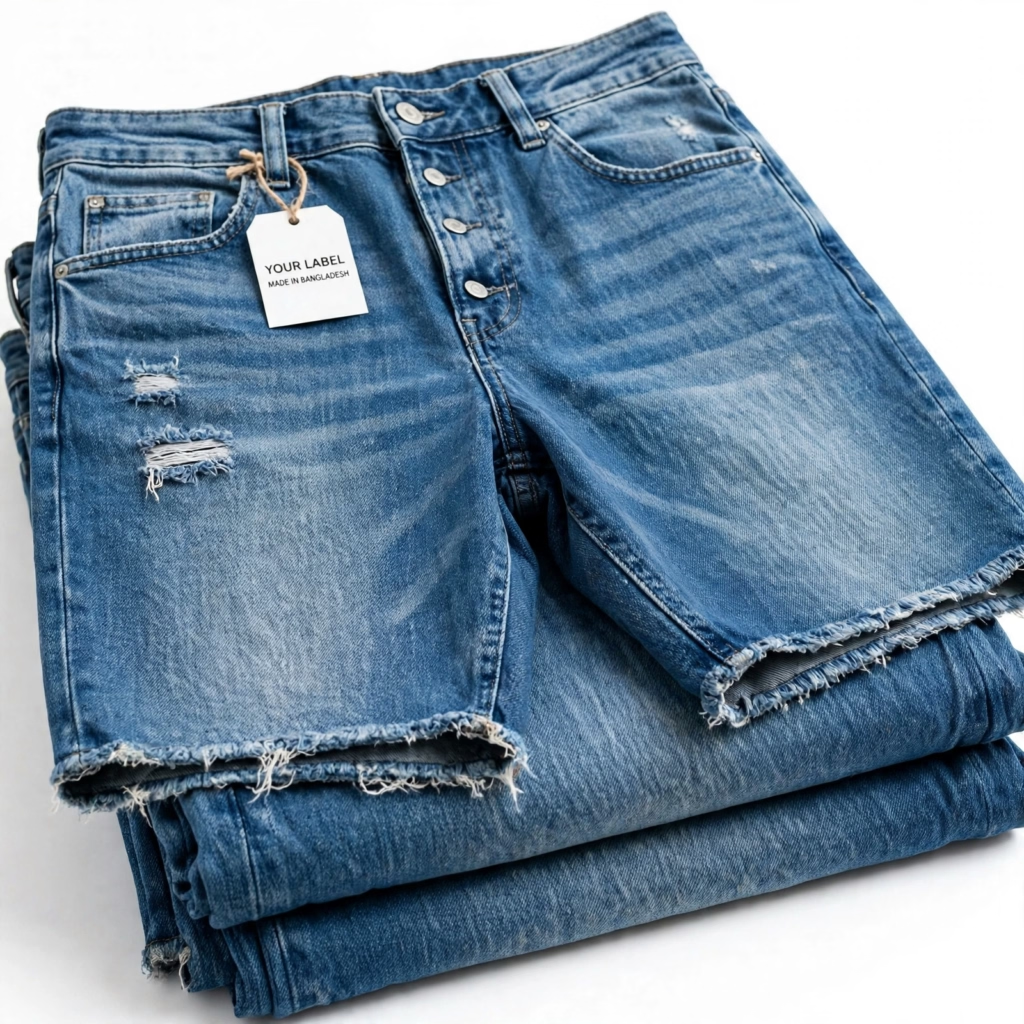
Every rip starts on the pattern, not on the finished garment. Placement is mapped so openings sit clear of pocket bags, fly stitching and seat seams, and each rip is sized on the sample first. Mild distressing is the house standard: the garment always stays complete, wearable and strong.
- Rips placed on the pattern, clear of pocket bags and seams
- Stitch reinforcement or backing patches behind open rips
- Frayed hems stopped with a stitch line so fraying stays put
- Five-pocket styling with rivets at stress points
- Bartack stitching at pocket corners and belt loops
- Zip or button fly to your specification
Pocket work follows the same discipline as our denim cargo shorts: pockets sit flat and bar-tacked, keeping the front clean around the distressed zones.
Customising Your Ripped Denim Shorts: Washes, Distressing and Trims
The distressing menu is built around your artwork and reference pairs. Rip number, size and position, whiskering at the front rise, hand-sanded abrasion zones and fray depth at the hem are each fixed on an approved sample, then repeated exactly.
- Rip number, size and placement mapped to your guide
- Whiskering and hand-sanded abrasion zones
- Frayed or clean-cut hems
- Stone, enzyme and rinse washes to an approved tone
- Your labels, back patches and hangtags to artwork
- Button, rivet and pocket-stitch colours to brief
Labels in Italy often push the wash on their shorts further, asking for paler stonewash tones and stronger abrasion at the thigh. The same distressing language carries into our ripped jeans, so a coordinated denim story matches across both garments.
Ripped Denim Shorts Sampling and Product Development for Canada and UK Buyers
Sampling proves the distressing before bulk is committed. Your sketch, tech pack or reference pair becomes a finished sample pair of shorts in your base size, with wash and rips placed exactly as bulk will run, so the approved pair is the received pair.
Canadian buyers often approve one wash depth first, then add a second tone once the rip map is proven. UK labels tend to test two distressing levels side by side and keep the milder one for core ranges. Either way, the approved pair is sealed as the production standard.
Ripped Denim Shorts Quality Assurance and Production Follow-Up
Distressed garments need closer checking than plain ones: every pair carries hand-finished work. As a family-run manufacturer, we hold the sealed sample beside the line: our quality team compares wash tone, rip position and fray depth against it through every bundle.
- Denim shade and wash tone checked against the sealed sample
- Rip position and size checked pair by pair
- Reinforcement stitching inspected behind every rip
- Fray depth checked so hems stay within the agreed line
- Measurements reviewed against your chart before packing
- Final pair-by-pair inspection before cartons seal
Buyers in Denmark ask for especially tight fray control, with loose threads trimmed to a set length on every pair. Any pair of shorts drifting from the standard is reworked or rejected before packing, never passed through.
Ordering Your Ripped Denim Shorts: Terms, Approvals and Repeat Orders
Starting takes one message: a tech pack, a reference pair or photographs of the distressing you want on your shorts. Drawing on 37 years of experience, we come back with denim choices and a sampling route, and the price is worked out style by style from your specification.
Payment and delivery terms are settled in writing before a single pair is cut, and approval stays with you at sampling, pre-production and dispatch. Buyers building a wider distressed story often add our distressed t-shirt styles, and repeats run straight from the sealed sample.
Shipping and Delivery of Your Ripped Denim Shorts Order
Finished pairs of shorts are folded and packed to your instruction, with tissue placed over distressed zones so frayed edges travel flat, and cartons are marked to your template. Consignments ship from Chattogram port, with Saudi Arabia served on regular sailings for buyers selling there.
Your booking follows the date your range has to land. Bulk orders travel by sea; air freight is there when a store launch cannot move. Before booking you receive the carton weights and dimensions, and your merchandiser confirms dispatch the day the vessel sails.
Ripped Denim Shorts Stories for Denmark and Italy Buyers
Danish labels keep distressing quiet: one or two small rips, a clean stonewash and fraying held to a short, even line, so the shorts sit inside a minimal wardrobe. Durability is the talking point, with reinforcement checked behind every opening before the style is approved.
Buyers serving Italy take the same garment in a fashion-led direction, asking for paler washes, stronger thigh abrasion and seasonal rip placements that change with each collection. Both markets start the same way: the distressing is mapped, sampled in the chosen denim and sealed before bulk cutting begins.
How USA and Australia Labels Build a Distressed Shorts Range
Labels in the USA usually open with two core washes, a mid blue and a stonewash, then rotate rip placements and fray levels as seasonal stories once the fit block is proven. The sealed sample keeps every repeat honest, whichever distressing level the season asks for.
Australian buyers plan around a long warm season, favouring lighter denims and shorter inseams, with milder distressing that survives heavy washing in home use. Because the approved pattern, wash standard and packing list stay on file, a repeat runs straight to cloth booking with no second development round.
Shipping to the USA, the UK and Australia
When the final pair passes inspection, cartons are built up exactly as your packing list sets out and loaded for the Chattogram sailings bound for the USA, the UK and Australia. Your own references are printed on every carton, so goods can be checked in against your order without opening a single box.
Most buyers move bulk volume by sea and keep air freight for launches that cannot slip. You receive carton weights and dimensions ahead of booking, keeping the landed cost fully visible, and a dispatch note from your merchandiser confirms the vessel as soon as it departs.