

Custom Men Dark Heather Ringer Blank T-Shirt Manufacturer in Bangladesh for Buyers in the USA, the UK and Germany
Work on this blank starts long before sewing: your heather colour reference, your size chart and your label file are read together, checked for clashes, and only then does cutting begin. One sample is approved in the lead size first; bulk never starts from anything else.
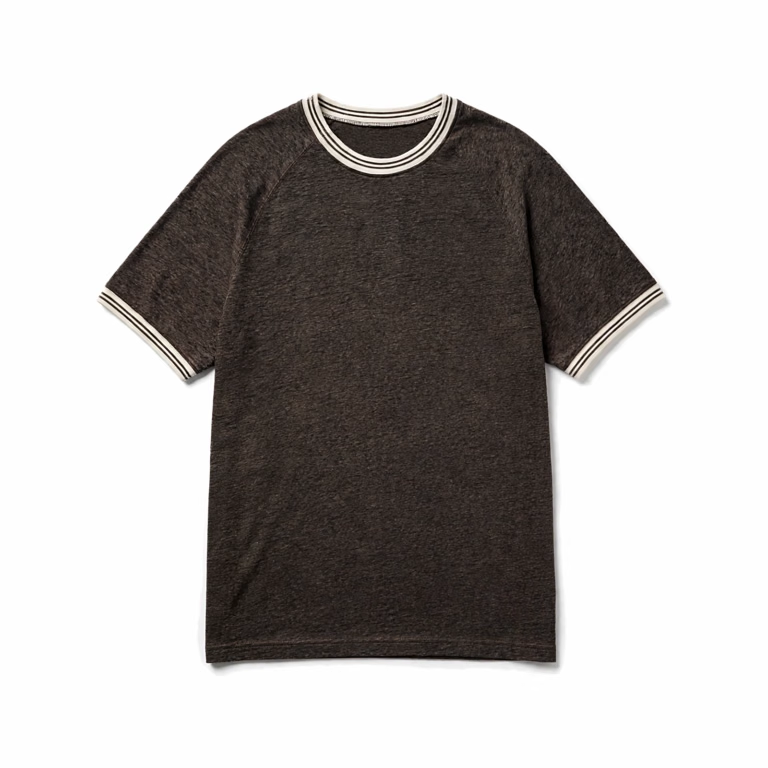
What the buyer is really ordering is a blank with its identity already sewn in: an off-white ringer collar band carrying two thin dark stripes, raglan seams running from the neck to the armpits, and matching striped bands finishing both sleeves. The chest itself stays completely empty.
That empty chest is the working surface. Body, sides and the whole of the back are plain dark charcoal-brown heather with no print and no embroidery anywhere, so the shirt waits exactly as it should for the buyer’s own artwork, applied later by the buyer’s own decorator.
The split personality is deliberate. Unprinted, the bands make the shirt read as a finished retro ringer on the rail; as a print base, the same shirt carries a buyer’s design without anything of ours competing with it. One brief covers both channels at once.
Briefing a Men’s Dark Heather Ringer Blank Tee Supplier, Step by Step
To brief us, send three things: the heather shade you want matched, your chart with chest, body and sleeve figures, and your label file. Buyers who already run charcoal graphic programmes will recognise the pack; the merchandiser replies with a costed sampling plan.
That plan names the four things the sample has to settle: how deep the charcoal-brown heather sits against your reference, whether the two stripes sit evenly in each band, how wide the bands finish at collar and sleeve, and exactly where the raglan seam line runs.
The cloth underneath is a poly-cotton heather jersey picked for blank work: a soft mottled marl surface, a comfortable stretch, moisture-wicking, light and breathable. As your custom men dark heather ringer blank t-shirt manufacturer in Bangladesh, we keep that cloth spec from sample to last carton.
The surface matters because somebody else prints on it later. Panels are checked for smoothness and even marl before they are sewn, since a decorator’s screen or transfer sits straight only on a flat, consistent ground, and the approved sample is the ground every bulk panel must match.
Canada Programmes: a Retro Ringer Blank Built for Print Shops and Event Ranges
In Canada this blank is usually bought ahead of a moment: a team merchandise run, a camp season, a festival weekend. A single ringer style does that work because it photographs as a finished garment for a listing and still takes a chest print cleanly when the event artwork lands.
Every size on the rail comes off the retailer’s own chart rather than a house block, so the fit a Canadian customer already knows is the fit that arrives. The marker holds the band width and stripe position constant at each size, from smallest to largest.
Dark heather earns its place in northern retail twice: rail marks and handling show far less on it than on pale grounds, and the off-white bands keep their contrast against it instead of washing out. Ranges run it through spring, repeat it for summer events, and again in autumn.
At packing, the buyer’s ratio decides the carton split, and stickers and barcodes are printed from the buyer’s files, not ours. Warehouses like the result: boxes book straight in because every code on the outside matches the tickets sewn and stuck inside.
One Blank, Two Jobs: Rail-Ready Ringer and Print Base
Nothing about this shirt is unfinished. The ringer bands are sewn garment bands, knitted with their stripes in place, not printed rings and not an afterthought trim; the collar band runs in a full circle and the sleeve bands finish both arms identically.
Printed later, the empty chest is the whole point: no house artwork, no crest, no lettering competes with the buyer’s design, and the clear field between the raglan seams gives a decorator a wide, flat placement area. The same discipline shows across our wider blank t-shirt programme.
Look closer and the detail holds: stripes even and continuous where each band curves, marl flecks spread evenly through the cloth with no pale patches, raglan seams straight along their diagonal. A blank is judged on exactly these small consistencies, because there is no print to hide behind.
One self-contained blank also ranges well. It can headline a retro capsule unprinted, carry a sports club’s chest print, or wear a retailer’s label as an event line, and in every case the garment underneath stays the same, which is what keeps reordering painless.
What Happens Before an Export Carton Is Sealed
Export work here follows a written sequence: the heather shade is proofed on cloth against the buyer’s reference, sewn panels are held against the approved sample under daylight lamps, and finished shirts are measured again at the final audit. On sampled pieces from every bundle, band width and stripe position are checked at collar and sleeve.
Packing is the buyer’s call, written into the order: folded or rolled, bagged or bare, ratio packs or solid sizes, carton marks printed from the buyer’s file. A custom men dark heather ringer blank t-shirt manufacturer in Bangladesh keeps its reorders by keeping that routine identical every time.
Final audit reads a shirt the way its buyer will: bands first, for even stripes and an unbroken circle at the neck; then the empty chest and the plain back; then both sleeves; then the label against the buyer’s artwork. Anything failing one of those four readings leaves the bundle before packing.
Wholesale Orders Sewn on the Same Lines as Brand Orders
Wholesale accounts choose this garment because it arrives uncommitted: an empty chest, a plain back, and no branding anywhere except the buyer’s own woven neck label. One production can therefore feed several of the wholesaler’s accounts without any of them seeing another’s name.
A repeat order does not restart the conversation. The jersey, the shade reference and the chart are already held, and cutting waits until the new panels match the retained sample. A custom men dark heather ringer blank t-shirt manufacturer in Bangladesh should treat a reorder as a continuation, and our floor does.
In Spain the blank sells through festival season and the club merchandise trade, and it suits both because the make is simple: one cloth, one colour, two striped bands, nothing beyond the buyer’s label. Quoted as a single clean line, it leaves the retailer’s margin intact.
The Size L Sample Comes First, the Grade Follows Your Chart
Sampling starts at size L because most men’s ranges are anchored there: fit, band width and the raglan line are all judged on the size the rest of the grade hangs from. Buyers comparing ringer styles can set this route beside our ringer t-shirt programme.
Once the sample is signed off, sizes step out along the buyer’s own increments, and the bands either scale gently with the body or hold a single width across the range, as the brief instructs. The heather shade and the stripe spec are never redrawn, so the blank survives every size unchanged.
Colour is settled on cloth, not on a monitor. Charcoal-brown heather can look almost black on screen, so the physical sample becomes the standard: the dye lot is matched to it, the band shade is matched to it, and every reorder is checked back against it.
Cutting, Band Sewing, Finishing: the Production Order
Sequence is what keeps a raglan blank honest. Panels are cut first, with the diagonal seam line marked true; the collar band and sleeve bands are attached while the panels are still flat and their stripe position can be measured; side seams and hems close last. Sew a band onto a made-up garment instead and the stripes drift with every seam allowance.
We are members of the Bangladesh Garments Buying House Association, and this blank is sewn on the same floor as our wider men’s t-shirt programme in Bangladesh.
A custom men dark heather ringer blank t-shirt manufacturer in Bangladesh is only as good as that floor’s habits, so buyers may audit them: at sampling, during production, or both, arranged through the merchandiser who runs the order.
Blanks get a gentle finish: a light press that sets the seams without flattening the marl, a lint pass, and a fold that leaves the collar band uncreased around its circle. Open the carton and the shirt is ready to photograph, or to print, the same day.
A Completely Plain Back, Bands Carried Round
Nothing stands on the back of this shirt, and that is a decision, not an omission. The back body is plain dark heather from shoulder to hem: no picture, no lettering, no second placement. From the front the customer gets the striped bands and the empty chest; from behind, a clean heather tee.
The bands still carry round, as a ringer’s should: the collar band circles the back neck with its two stripes showing, and both sleeve bands finish the arms exactly as they do at the front. The raglan seams run the same diagonal on the back panels, so the shirt reads as one garment from every side.
One thing only is added to the garment: the buyer’s woven label, black with the name in white, folded into the back neck seam and stitched at both ends, exactly as the buyer’s label file draws it.
Plainness at the back is also commercial protection. Nothing in the design can be misread from behind, no second print position adds cost, and the shirt hangs, folds and photographs identically in every listing it appears in. The offer is one honest blank, presented plainly.
Occasionally a buyer, often one shipping to Australia, asks whether a printed version could join later orders. It could, as its own brief; it is not part of this garment. The sample shows a plain blank, so a plain blank is what bulk delivers.
From First Brief to Sealed Carton: How an Order Runs
The sequence never varies: brief in, shade reference and chart checked, the size L sample sewn and photographed for approval, grading confirmed, panels cut, bands sewn, finishing, audit, packing. A stage must close before the next one opens, which is why questions about the bands are settled at sampling stage.
Starting is deliberately light: send the shade reference and the chart your range already runs on, and the sampling room replies with a costed plan for the shirt. A custom men dark heather ringer blank t-shirt manufacturer in Bangladesh should make that first step simple, and here it is.
From brief to carton the buyer deals with one merchandiser, the person running the order, who keeps the approved sample on the desk and answers for the cloth, the bands and the chart directly. Nothing is relayed down a chain.
Can a print shop in Germany approve the blank before bulk starts?
Yes, and nothing sews in bulk before that sign-off. The size L sample is made on the production cloth to the buyer’s own reference, so the buyer in Germany approves the heather depth, the stripe placement and the band width exactly as bulk will repeat them.
What does a retailer in Portugal need to send for its own label version?
Two files: the label artwork and the size range it sells. Our floor sews that retailer’s black woven label into every neckline instead of any house mark, while the shirt itself, bands, raglan seams, plain back and all, stays exactly the same garment.
How does a wholesaler in Canada repeat an order?
By reference, not by resampling. The retained sample and the held shade reference come back to the floor, new panels are matched against them, and the order rejoins the routine at cutting, with placement, heather shade and chart measures repeating as they were.
What should a buyer in France look at first on the sample?
The bands, at full size: stripes even and continuous, the collar band in one unbroken circle, the sleeve bands matched to each other. After that, the raglan seams, the plain heather back, and the shirt’s measures against the chart.