
Custom Mens Australian Football Singlet Manufacturer in Bangladesh for Clubs
A custom mens australian football singlet manufacturer in Bangladesh is judged on grand final day: does the guernsey still read as one club from the back row of the stand? Colours true, print placed, binding clean – a singlet is a club’s flag worn at running speed, and it is made like one here.
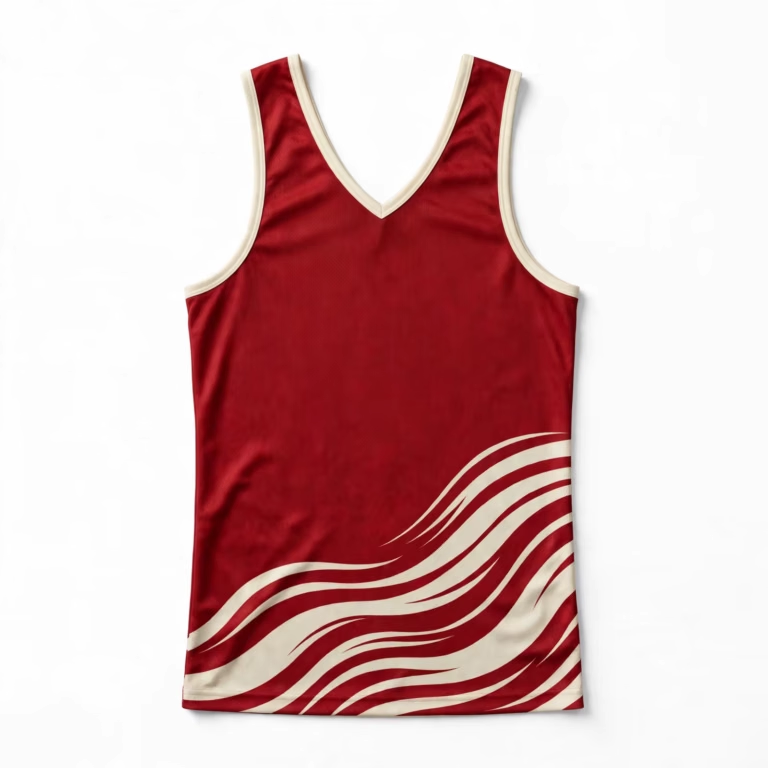
This red singlet is made at your level: your quality in the knit and the print, your fabric weight and hand, your design in the V, the binding and the wave, your measurement chart behind the fit. A club standard, sewn the same way for the senior side and the juniors.
Materials – Your fabric call sets the cloth: a deep red lightweight sports knit with cream binding at the neck and armholes. The wave print is laid in cream across the lower body, printed to your colour standard and checked against it in daylight.
Functionality – Your design sets the garment: a deep V-neck bound in cream, sleeveless with bound armholes cut for a full tackling reach, and a straight hem. The back is left clean for your club’s own numbers, applied by your club or your local printer.
Size – Your measurement chart rules the fit: chest, length and armhole depth graded from your chart, with the print placement graded with the body, so the wave sits at the same height on a small and a triple-extra-large. Identity that drifts with size is not identity.
Customisation – Your level covers the whole garment: your club colours beyond this red, your own artwork in place of this wave, your label inside the back neck. Quality, fabric, design and measurement follow your club’s standard from sample to sealed carton.
Order the sample singlet and judge it from twenty metres, the way a supporter sees it. Start through the contact page with your chart and colours.
The Red Singlet, Piece by Piece
The front carries the deep V with its cream binding meeting in a clean point, the red body plain through the chest, and the cream wave sweeping diagonally across the lower body, rising from the hem toward the right side. The armholes are bound in the same cream.
The back repeats the binding at the neck and armholes, the wave continuing across the lower back, and the upper back left completely clean. No numbers, no names, no logos are printed here: those are your club’s to add, in your club’s own hand.
- Deep V-neck, cream binding
- Sleeveless, bound armholes
- Cream wave print, lower body
- Upper back clean for club numbers
- No logos or text printed
A Guernsey Is a Flag, and Flags Are Matched Exactly
Twenty-two players in almost-the-same red is a team in two kits. Club identity lives in exactness: the same red, the same cream, the same wave height on every body on the field, from the first player picked to the last junior registered.
That exactness is a process, not a hope: one cloth lot and one print run per club order, colour checked in daylight against your standard, and the wave placed from a marker that grades with the pattern. The sample you approve is measured, photographed and kept as the club standard for every reorder.
Football Singlet Supplier in Bangladesh for Australian Clubs
Australian clubs order against a season start that does not move, in two waves: the main list before round one and the top-up when registrations surprise. The supplier’s job is to make the second wave indistinguishable from the first.
Your club’s colours, artwork file and chart stay on record here, so the top-up run prints from the same file, on the same knit, to the same standard. A player who joins in May wears the same guernsey as the player who signed in February.
Clubs also replace singlets one at a time through a season: torn, lost, outgrown. A small standing reorder, even a handful of pieces in mixed sizes, runs off the same record, so the replacement that arrives in July is a twin of the set, not a near relation that stands out in the team photo.
- Colours and artwork held on record
- Top-up runs match the main run
- One cloth lot per club order
- Wave placed from a graded marker
Build Sheet for the Red Singlet
The build sheet is the guernsey reduced to decisions: knit, red, cream, V depth, wave placement. Kept beside the approved sample, it is the contract every later run, including next season’s, is sewn against.
| Fabric | Lightweight sports knit |
|---|---|
| Colour | Deep red body, cream binding |
| Neckline | Deep V, bound in cream |
| Sleeves | Sleeveless, bound armholes |
| Cream wave across the lower body | |
| Back | Clean, ready for club numbers |
| Fit | Athletic, full reach armhole |
| Sizes | Junior and senior, graded to your chart |
| Label | Your woven label inside the back neck |
The Wave Is Placed, Not Printed and Hoped
A motif that climbs with size turns one design into five. On this pattern the wave is placed from a graded marker: its rise from the hem and its angle are set per size, so the design a supporter sees is the design the club approved, on every body.
Your club’s own artwork gets the same discipline when it replaces this wave: the file is set at each size, a printed sample is checked at the smallest and largest, and only then does the run print. Placement is a spec, never a surprise.
Numbers Are Yours, and the Back Is Ready for Them
Clubs guard their numbers: the font, the size, who wears which. This singlet ships with the upper back clean and flat, the knit smooth and print-free in the number zone, ready for heat press or screen work by your club’s own printer.
If your club prefers the numbers applied before shipping, send the number file and the list by size, and they are applied here to your spec and checked against the list twice. Either way, the decision stays the club’s, where it belongs.
- Number zone kept print-free
- Knit smooth for heat press work
- Optional application to your number file
- List checked twice before packing
Team Singlet Exporter in Bangladesh for New Zealand and UK Clubs
The same garment travels: Australian rules is played in New Zealand, across the UK and in leagues from Canada to Germany, and every club has the same problem – a proper guernsey, in club colours, without a local maker who understands the cut.
Your club sends a chart, colours and artwork; the sample comes back for a distance check, and the run follows. The deep V, the bound armhole and the clean back are the game’s own pattern language, spoken the same way in every country that plays it.
From Distance Check to Sealed Club Carton
A club sample is judged at distance and at arm’s length: colours read from twenty metres, then binding, print edge and stitching read up close. Both judgements are recorded before the run, because a guernsey must pass both every week of the season.
Finished singlets are folded flat, print side protected, and packed by size with the size list on the carton. The gear steward opens one carton and dresses a team; that is the standard the packing is set to.
- Sample judged at distance and close
- Both readings recorded before the run
- Folded flat, print protected
- Packed by size for the gear steward
Juniors and Seniors in One Identity
A club’s juniors wear the big club’s colours like a promise. Here the junior and senior runs share the knit, the red, the cream and the wave marker family, graded from one chart family, so the under-12s and the senior side are visibly one club on the same morning.
Your club sets where junior grading hands over to senior grading. One decision, made once, keeps every team photograph at the club looking like the same family album.
There is a practical side too: parents buy the junior guernsey expecting it to survive being handed down, and the knit and binding are specced for that second and third life. A junior singlet that still looks sharp on a younger brother is the club’s quietest advertisement at every Saturday registration table.
The Rest of the Match-Day Kit
The singlet sits inside a full sportswear floor. The royal blue activewear set cover the other code, and the sky blue tracksuit set covers warm-ups.
The dry-fit athletic joggers cover training nights, while the tracksuit line covers team travel.
Trade buyers can follow Bangladesh’s sportswear exports through the International Trade Centre.
The Tackle Test: Armholes, Seams and Stretch
A singlet’s working life is measured in grabs. The armhole is cut deep for reach but bound firmly, because a bound edge is what a grabbing hand meets; the side seams are stitched to lie flat and take a sideways pull without sawing at the skin.
At sample stage, pull the sample the way the game will: armhole against a full reach, side seam against a hard sideways load, V point against a downward grab. A guernsey that survives its own sample test has earned the run; one that opens anywhere goes back to the bench, not onto the field.
- Armhole bound for the grabbing hand
- Side seams flat under sideways load
- V point reinforced at the meet
- Sample pull-tested before the run
A Season in the Wash Bag
Club kit is washed the way it is played: hot, often and without ceremony. The red is dyed for that life and the cream print is checked after washing at sample stage, because a wave that fades to grey by round six makes the whole team look tired before it takes the field.
The knit is chosen to dry fast and hold its shape out of the bag, so the singlet a player pulls on at training on Tuesday is the same shape he wore on Saturday. Shape memory is not a luxury in club kit; it is the difference between a guernsey and a rag by August.
Questions Buyers Ask About Football Singlets
Can an Australian club replace the wave with its own artwork?
Yes. Your artwork file replaces the wave on the same placement discipline: set per size, sampled at the smallest and largest, and printed only after your club approves both. The red, the binding and the cut stay exactly as sampled unless your club changes them.
Can a UK club order junior and senior singlets in one run?
Yes. Both grade from one chart family with the same colours and artwork, and they are packed by size for your gear steward. The handover point between junior and senior grading is set by your chart at sample stage.
Can a Canadian club have its numbers applied before shipping?
Yes. Send the number file and the list by size; numbers are applied to your spec and the list is checked twice before packing. Clubs that prefer their own printer receive the backs clean and press-ready instead.
Starting a Club Singlet Programme
Start with two singlets, your smallest junior and your largest senior, and judge them the way the game will: at distance for identity, up close for workmanship, and after a wash for colour truth. A guernsey that passes all three will pass a season.
Once they pass, your colours, artwork file and chart stay on record as the club standard, so reorders and top-ups are a phone call, not a new negotiation. Send your chart through the contact page, and the first samples are cut against it.
Keep one spare singlet from the first run at the club as your own reference. When a later batch arrives, lay the two side by side in daylight before a ball is bounced in them; identity is easiest to protect in the first five minutes, and your club’s own sample makes the comparison instant and fair.
That five-minute habit, kept every season without fail, is what stops a slow colour drift from ever reaching the field unnoticed by anyone at the club.