
Wholesale Sweaters Manufacturer in Bangladesh for Hungary
For a Hungarian knitwear buyer, a sweater has to earn its rail space: honest warmth, a colour that survives the season and a fit that stays true after washing. Every order here is knitted new in Bangladesh against the buyer’s own written specification, matched panel by panel to an approved sample.
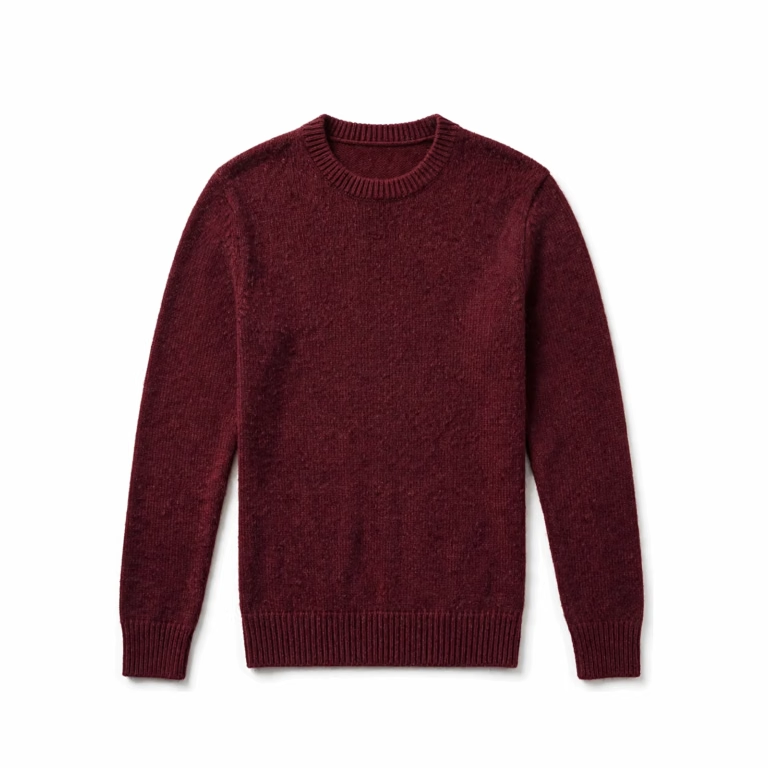
Pictured on this page is a men’s crew-neck sweater in mid burgundy, size L, worked in a fine to medium gauge plain knit whose stitches you can read with the naked eye. Ribbing closes the collar, both cuffs and the hem, and the rest of the garment is left completely plain.
Knitted to Order, Never Drawn From a Shelf
Work begins with paper, not yarn. The buyer’s specification fixes fibre, gauge, colour, measurements and label artwork in one document, and the knitting floor treats that document as the order itself. Until it is signed off, no cone is threaded and no panel is started for the programme.
From that point the document travels with the goods. Panels are linked to the pattern, seams follow the construction notes and cartons follow the packing plan, so what arrives in Hungary is the buyer’s product in every detail. The route mirrors the one behind our sweater manufacturer Bangladesh programme: brief first, sample first, bulk last.
The Burgundy Knit and Its Readable Stitch
A plain stitch at this gauge gives a smooth face at arm’s length and a clearly readable yarn up close, which is exactly how a customer judges knitwear in the hand. Across body, sleeves and back the mid burgundy reads as one even tone, with no panel standing lighter or darker.
How heavy the knit feels is decided in the buyer’s office, not on our floor. Lighter gauges serve layering and transitional ranges; a denser knit serves the coldest selling weeks. Before knitting starts, the chosen yarn is tested for evenness, cleanliness and washing behaviour, and only clean results go forward.
- Panels knitted to the gauge named in the buyer’s specification
- One dyed yarn lot across body, sleeves and ribbed trims
- Stitch structure and yarn texture visible at natural distance
- Colour standard supplied by the buyer, matched before knitting
Collar, Cuffs and Hem in Matched Ribbing
At the neck, a ribbed band forms the crew collar and is linked into the body rather than stitched over it, leaving a smooth join that lies flat and keeps its spring. The band’s recovery is checked on the sample after washing, because a slack collar ends a sweater’s selling life early.
The same ribbing closes both wrists and the lower edge, tensioned to hold the garment’s outline without gripping. Body length is kept full and honest: the hem finishes level with the cuff ends, the way a properly proportioned sweater hangs when it is worn, never shortened for the photograph.
Left Plain on Purpose, Ready for Your Mark
Nothing decorates this body: no chest motif, no embroidery, no lettering on front, back or sleeves. That plainness is the offer. The sweater can carry a buyer’s own badge or crest later, or sell untouched under the buyer’s label, exactly as it leaves the finishing table here.
Where a range does call for decoration, the addition is proved on a sample first, stitched onto the same knit in the same colour, and only released when the buyer passes it. Buyers developing mens pullover sweater manufacturer Bangladesh lines use this same plain base and the same approval step for their own artwork.
Colour Control From Cone to Carton
Burgundy punishes careless dyeing: one lot drifts red, the next drifts brown, and a rail of mixed shades sells badly. The defence is a single reference, supplied by the buyer as a colour code, a cut swatch or a kept garment, against which every dye decision on the order is judged.
Because body, sleeves and trims all come off one dyed lot, drift between panels cannot happen. Readings under a fixed light are taken twice, once when the sample is judged and once when the first bulk panels leave the machines, and a shade that misses the reference stops the run.
- Dye reference held from the buyer’s own standard
- One yarn lot for the whole garment, trims included
- Shade readings at sample stage and at first bulk panels
- Kept sample used as the colour target on every reorder
Gauge and Weight Chosen by the Buyer
Warmth can be specified like any other measurement. A buyer selling into a mild coastal winter orders a lighter hand feel; a buyer supplying mountain towns orders density. The sample is knitted to the requested weight so the decision is made on a real garment, not on a description.
Fibre follows the same discipline. Whatever yarn the specification names is the yarn that gets knitted, and its behaviour is proven during sampling: wash response, surface pilling and shape recovery are all read on the sample, and any weakness sends the choice back for correction before bulk is authorised.
Sizes Graded From the Buyer’s Own Chart
No house size ladder is imposed on this programme. Chest, length, shoulder and sleeve for each size come from the chart the buyer sends, because that chart describes the customers the buyer already serves. Grades are knitted to those figures and measured against them before the order proceeds.
The gallery sweater shows the result: a men’s size L, regular through the body, hem level with the cuffs. A buyer wanting a trimmer fashion fit or a more generous workwear fit simply writes it into the chart, and the revised sample demonstrates the change before a single bulk panel is knitted.
A Sample You Approve Before Any Bulk Exists
Trust is not a production method here; a garment is. One sweater is knitted from the buyer’s papers, finished completely, and sent out for judgement while the bulk yarn waits untouched. Production quantities are released only on written approval, and the reply to an enquiry always starts with that sample.
Approval turns the sample into the benchmark for everything that follows. Yarn, shade, gauge, collar behaviour, label placement and measurements are compared garment by garment against it during the run. A requested change re-enters through a fresh sample; it is never improvised halfway through bulk knitting.
Construction Read Garment by Garment
Buyers forgive many things, but not a twisted body or a collar that bags. Shoulders here are linked to bear the knit’s weight evenly, side seams are set true, and the collar band is centred on the neck opening, so the sweater hangs squarely on a hanger and on a wearer alike.
The inside gets the same attention as the outside. Stitch evenness is read across every panel, looking for dropped rows or thin places; seam allowances are laid flat so nothing chafes; loose ends are trimmed; and each finished piece is examined inside and out before it is allowed to be folded.
Checks Placed Along the Line, Not at the End
Inspection is built into the route rather than bolted on afterwards. Yarn is read before it reaches the machines, linked panels are read before trims are attached, and the completed sweater receives a final examination covering collar shape, measurements, stitch quality and cleanliness before it enters a carton.
A failing piece leaves the run at the point where the fault is found. It is not carried forward in the hope that finishing will hide it. That single habit explains why the final carton of a large order still agrees with the sample the buyer signed, piece for piece and shade for shade.
- Yarn checked for shade and evenness before knitting begins
- Panels checked after linking, before any trim is attached
- Finished sweaters measured against the buyer’s own chart
- Final read covering collar, stitching and cleanliness
Your Label in the Neck, Your Name at the Rail
Inside the back neck sits the identity that matters commercially: the buyer’s woven label, stitched in during making and shown in the gallery’s YOUR LABEL view. Hang tags and outer packing can carry the same identity, so the sweater introduces the buyer’s brand at every point where it is handled.
Supplying that label is easy. Send finished artwork with the enquiry and the sample arrives already wearing it; alternatively, wording can be prepared here and approved by the buyer before knitting starts. Either way, no garment leaves with a placeholder where the buyer’s name should be.
Packing Decided With the Order, Not After It
Cartons are planned while the order is still paper. Fold style, size assortment and colour grouping are written into the specification, and outer marks are set so a receiving team can shelve sizes quickly without opening every box. The finished cartons are then counted against that plan before release.
Individual bags, mixed size cartons, printed marks or plain board are the buyer’s choices to make, and they are recorded alongside the garment details rather than settled at the door. By the time production ends, packing holds no surprises for either side of the shipment.
Wholesale Sweaters Supplier in Bangladesh for Germany Importers
German importers buy knitwear on documentation: a shade, a gauge and a measurement set that repeat exactly across a season. This programme supports that habit by freezing the approved sample as the standing reference, so delivery five reads like delivery one and a reorder needs no renegotiation of the garment itself.
For a German range, the pictured sweater is that reference in visible form: one yarn, one crew neck, one set of ribbed trims, graded through the size range from the buyer’s chart. Sampling is scheduled ahead of the selling season, leaving production calm weeks instead of a late scramble.
Wholesale Sweaters Exporter in Bangladesh for Spain Retailers
Spanish retailers dress a shorter, milder winter and tend to ask for a softer hand feel with an uncluttered presentation. This burgundy knit suits that brief: plain stitch, neat crew neck, trims that keep their line, and nothing printed or embroidered that the retailer did not request in the first place.
Spanish buyers frequently place knitwear alongside ladies lines, and one paperwork discipline covers both. The route used for ladies casual knitted sweater exporter manufacturer Bangladesh programmes is the same one used here: each market’s order held to its own specification, its own colours and its own size curve.
Wholesale Sweaters Wholesaler in Bangladesh for Canada Distributors
A Canadian distributor needs knitwear that tolerates hard use: frequent washing, heavy rotation and cold that tests every seam. Linked shoulders, even stitching and firm ribbed trims are specified on this page with that working life in view, and the sample is washed before approval so weakness shows early.
Reorders are where the made to order route pays a distributor back. Nothing is drawn from ageing shelves; the repeat is knitted again from the approved papers, in the size curve and colour set the new season calls for. The garment a customer buys this winter matches the one bought last winter.
The Same Lines Serve Many More Markets
Germany, Spain and Canada illustrate the programme; they do not limit it. Identical making lines produce these sweaters for buyers in France, the Netherlands, Belgium, Sweden, Norway, Portugal, Denmark, Greece, the United Kingdom, Australia, New Zealand, the United Arab Emirates, Saudi Arabia and Oman, each to separate papers.
A uniform sweater for staff and a fashion sweater for retail differ only in the document behind them. One may gain a small embroidery in the buyer’s market; the other stays plain like the burgundy body pictured. Both pass through sampling, approval and the same staged checks before bulk knitting is released.
Why Hungary Looks to Bangladesh for Knitwear
Hungarian winters are properly cold, while Hungarian retail prices must stay sensible, and that pairing shapes every buying decision. Bangladesh meets it with long knitwear experience, careful hand finishing and yarn economics that let a genuinely warm sweater reach the shelf at a price a shopper will accept.
The distance between the two countries is managed by the calendar. Sampling closes early, production is booked against the selling season, and cartons arrive marked for fast checking. What a Hungarian buyer receives is the approved garment, in the sizes ordered, ready to go straight onto the rail.
Washed, Measured and Finished Before Approval
Knitwear is judged twice: once on the rail and again after the first wash at home. For that reason the sample is washed and remeasured before any approval is requested, proving that the fit and shade a customer tries in the store are the fit and shade that come back from the laundry.
Finishing is likewise written down in advance. Pressing method, fold style and any care labelling the buyer’s market requires are settled in the specification, and bulk finishing follows that written plan exactly. Nothing at the packing table is left to somebody’s habit on the day the cartons close.
Order at Your Level: Your Quality, Fabric, Design and Measurement
Starting an order takes three things: a colour standard, a size chart and label artwork. From those, this wholesale sweaters manufacturer in Bangladesh for Hungary produces the sweater a range actually needs, because your quality, your fabric, your design and your measurement form the specification itself rather than an optional extra.
One claim on this page can be verified by any buyer within minutes: we are members of the Bangladesh Garments Buying House Association. Everything else is proved the practical way, through the Get a Price route on this page, where the conversation opens with a sample made to the buyer’s own papers.
Read More: Wholesale Sweater Questions Buyers Ask
Can I order these sweaters with my own label for Hungary?
Every sweater in the run carries the buyer’s woven label in its back neck, placed exactly where the gallery’s YOUR LABEL photograph shows it. Send the artwork with the first enquiry and the sample arrives wearing it, so the approval judgement covers the label as well as the knit.
How is the knit gauge and weight set for our range?
The setting comes from the buyer, not from a house default. State the selling conditions, deep winter cold or milder layering weather, and the sample is knitted to that weight and hand feel. Judgement happens on the physical sample, and bulk follows only the gauge the buyer has passed.
Can the sweaters be made in our own size range and fit?
Yes, grading begins with the buyer’s figures rather than a standard ladder. Send the sizes sold and the fit wanted, closer for a fashion rail or easier like the size L pictured, and each grade is sampled, measured and corrected against that chart before bulk knitting begins.
Do you match the burgundy to our own colour standard?
Matching needs a physical target: a colour reference, a cut swatch or a garment kept from an earlier run. Yarn is dyed against that single target, the sample demonstrates the match on real knit, and approval fixes the shade for the entire production run that follows it.
Which markets do you supply with wholesale sweaters?
Current programmes run to Hungary, Germany, Spain and Canada, with the same lines also serving France, the Netherlands, Belgium, Sweden, the United Kingdom, Australia and the United Arab Emirates. Each destination receives fresh making from Bangladesh, produced to one buyer’s papers and packed to that buyer’s plan.