
Wholesale Workwear Manufacturer in Bangladesh for Tanzania
Industrial buyers in Tanzania need workwear that survives heat, dust and long shifts without losing its shape or its colour. Siatex makes every coverall order fresh in Bangladesh to the buyer’s own specification, and each garment is checked against the approved sample before it leaves the sewing floor.
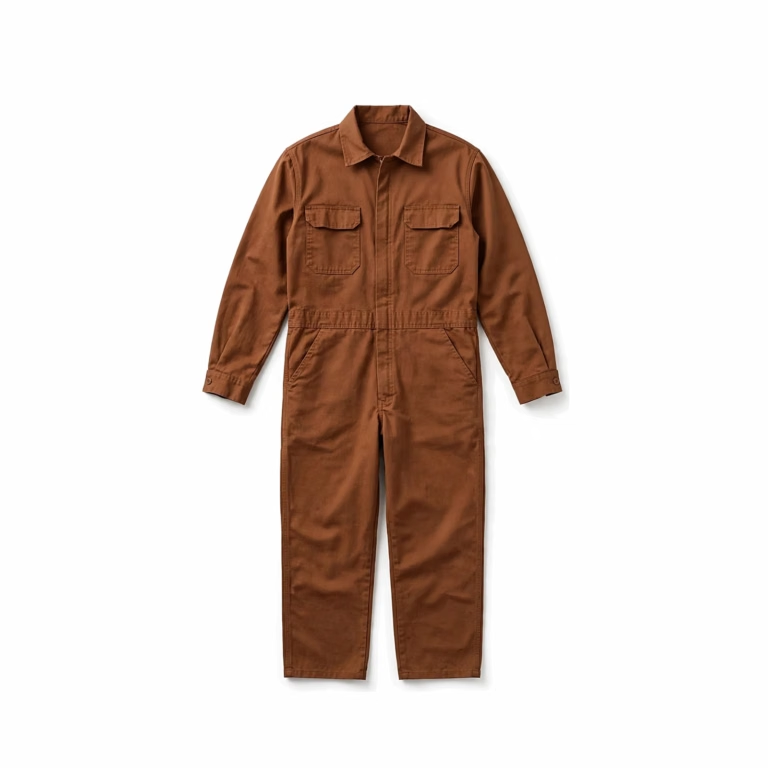
The garment on this page is a men’s one-piece coverall in mid rust brown cotton and polyester twill, size L, with a shirt-style collar and a concealed front zip hidden under a plain flap. Flap chest pockets, side pockets and plain buttoned cuffs complete a deliberately plain working garment.
Coveralls Cut Fresh to Each Buyer’s Own Specification
Nothing is cut from a guess. Your order begins as a document: the twill, the rust brown, the zip and flap, the pocket layout, every size and the neck label are written down by you, agreed with us, and only then does cloth move toward the cutting table.
From that sheet, every hand on the floor works to the same page: cutters follow your pattern, machinists follow your construction notes, finishers follow your packing plan. The coverall that reaches Tanzania is therefore your product in every seam. The same discipline governs our reliable customised workwear factories for the US market lines.
Rust Brown Twill With a Weave You Can Read
The body cloth is a cotton and polyester twill with a clear diagonal weave that stays readable at natural distance. The mid rust brown tone holds even across the chest, the sleeves, the legs and the back, so the garment reads one colour everywhere it is seen.
How heavy the cloth feels is decided in your office, not on our floor. Choose a lighter twill where crews work under a hot sun, or a denser weave where the day means abrasion and daily washing. Before cutting, each roll is read for even weave, clean surface and wash shrinkage.
- Cotton and polyester twill woven to the buyer’s chosen weight
- Diagonal weave and yarn texture readable at natural distance
- Rust brown ground dyed to the buyer’s own colour standard
- Plain buttoned cuffs and a firm collar holding their shape
Collar, Zip Flap and Buttoned Cuffs
At the neck sits a shirt-style collar that lies flat and even, its points matching on both sides. Beneath it, the front zip runs straight down the centre of the body, concealed under a plain fabric flap, so the front reads clean and nothing snags at work.
The sleeves close with plain buttoned cuffs, each button real, round and evenly set, and the cuffs sit at the wrist where a working sleeve should end. Long sleeves hang straight down close alongside the body, never folded, rolled or spread wide for the photograph.
Chest Pockets, Side Pockets and a Plain Waist
Two chest pockets with flaps sit square on the chest, their flaps straight, centred and stitched to hold tools, pens and small parts through a working day. Side pockets open at the waist where hands naturally fall, cut deep enough to be useful and finished cleanly inside.
The waist is plain and honest, sewn to the measurement on your chart rather than gathered by guesswork, and the legs run straight from hip to ankle. Both legs lie close together, hems side by side, at the full natural length a working coverall needs.
Left Plain on Purpose, Ready for Your Own Marking
Look over the whole garment and you will find no decoration at all: nothing printed, nothing embroidered, no letters, no reflective tape on chest, sleeves or legs. That emptiness is deliberate. The coverall is a clean working surface, ready for your own marking, or ready to be issued exactly as it stands.
Should your range call for a name across the chest or a small embroidered badge, it is proved on a sample first, stitched onto this same twill in this same colour, and released only when you pass it. Buyers who came through coverall in Saudi Arabia from a Bangladesh workwear manufacturer followed exactly that route.
Colour Held True From Roll to Roll
Rust brown is a forgiving colour on a workwear rail, but it still drifts when dyeing is careless: toward orange it looks cheap, toward darkness it looks tired. Your standard settles the argument before it starts, sent as a colour reference, a cut swatch or a garment from an earlier run.
One dye lot covers the whole garment. Collar, flap, pockets, sleeves and legs are all cut from cloth dyed together, so no panel can sit lighter or darker than its neighbour. The shade is checked under one fixed light twice: when you judge the sample, and when bulk cutting begins.
- Garment dye matched to the buyer’s own colour standard
- Collar, pockets and body cut from one dyed cloth lot
- Shade checked under consistent light at sample and bulk stages
- Approved sample held as the matching target for reorders
Cloth Weight and Blend Chosen by the Buyer
Warmth and toughness can be specified like any other measurement. A buyer clothing outdoor crews in a hot climate orders a lighter, breathable hand feel; a buyer supplying workshops and depots orders density. The sample is sewn to the requested weight so the decision rests on a real garment.
The fibre mix is written by you and woven as written. Name the balance of cotton to polyester your crews prefer, and sampling proves how that exact cloth behaves: how it washes, how its surface wears, how well it recovers its shape. A cloth that disappoints is changed before bulk, never after.
Sizes Graded From the Buyer’s Own Chart
Your measurements rule here; ours do not. Send the chart your crews are sized by, and chest, length, shoulder, sleeve and leg are graded from those figures alone, size by size. Each grade is then sewn as a check garment and measured against the chart before the order is allowed to proceed.
The gallery coverall shows the result: a men’s size L with a full natural length from collar to ankle, its sleeve cuffs ending beside the body at the wrist line. A buyer wanting a roomier fit for layered clothing simply writes it into the chart, and the revised sample demonstrates it.
A Sample You Approve Before Any Bulk Exists
No bulk sewing starts on a promise. The first thing this programme makes is one single coverall, sewn from your papers in your twill and your colour, finished completely and posted to you. While you judge it, the bulk cloth stays on the roll, and production waits for your written word.
Once you pass it, that sample governs everything. Every later garment is held against it: same cloth, same shade, same weight, same pocket placement, same label position, same measurements. If you want something changed, the change is sewn into a new sample and judged again; it never slips quietly into the bulk.
Seams and Closures Read Garment by Garment
A coverall earns its keep standing straight. Here the shoulders are balanced so the garment does not twist on the body, the side seams run true from armpit to ankle, and the zip sits dead centre under its flap, so the suit hangs square on a rail and moves square on a worker.
Turn the garment inside out and the reading continues. Allowances lie flat so nothing rubs through a long shift, stitch lines are checked for skips and weak runs, and loose thread ends are cut away. Only a coverall that reads clean on both faces is folded and passed to packing.
Checks Placed Along the Line, Not at the End
Faults are cheapest where they are born, so checking is spread along the whole route. Yarn and cloth are read on arrival, part-sewn panels are read before pockets and flaps are set, and the finished coverall faces one last full reading: collar, zip, measurements, stitch quality and cleanliness, before any carton closes.
A panel that fails its reading comes straight out of the run. It is never sewn onward in the hope that a later stage will hide the fault, because hidden faults multiply into cartons. That is how the last box of a large order still matches the sample you signed off.
- Cloth inspected for shade and surface before cutting begins
- Sewn panels checked for pocket position before finishing
- Finished coveralls measured against the buyer’s own chart
- Final inspection covering collar, stitching and cleanliness
Your Label in the Neck, Your Name at the Rail
Open the back neck of the finished coverall and you find the name that matters at the depot: yours. Your woven label is sewn in during making, in the position the gallery’s YOUR LABEL view shows, and the same identity can continue onto hang tags, bag printing and carton marks.
Getting your label onto the garment takes one file. Send the finished artwork with your enquiry and the sample arrives already wearing it; if you have no artwork ready, wording can be drafted here and sent to you for approval first. No coverall leaves with a blank where your name belongs.
Packing Decided With the Order, Not After It
Packing is agreed while the order is still a document, not improvised at the door. How each coverall is folded, how sizes and colours are assorted, and what each carton says on its face are all written into your specification, and the packed cartons are counted against that plan before release.
The choices stay yours throughout: single coveralls in bags or folded loose, cartons of one size or mixed assortments, printed marks or plain board. Each choice is recorded beside the garment details in your specification, so by the time the sewing ends, the packing holds no surprises for either side.
Wholesale Workwear Supplier in Bangladesh for Germany Importers
Importers in Germany clothe crews on paperwork that must hold for a whole season: one shade, one cloth weight, one measurement set, repeated without drift. This programme is built for that habit. Your approved sample stands as the reference for every delivery, so a reorder is a repetition, not a renegotiation.
Look at the coverall in the gallery and you are looking at the German reference itself: a single twill, a single collar, a single concealed zip and pocket layout, graded through every size from your chart. Sampling is booked ahead of the season, so production runs in calm weeks, not in a late rush.
Wholesale Workwear Exporter in Bangladesh for Spain Companies
Spanish companies clothing agricultural, warehouse and workshop crews ask for a lighter hand feel and a clean, plain presentation, and this rust brown twill answers it: a readable weave, a neat collar and closures that keep their line, with nothing printed that the company did not request first.
Buyers in Spain often run coveralls beside bib and brace or two-piece workwear sets, and the same discipline travels across them: one specification system, one sampling route and one approval gate. Programmes gathered under wholesale workwear manufacturers suppliers show that pattern, with every market’s order held to its own papers.
Wholesale Workwear Wholesaler in Bangladesh for Canada Distributors
Distributors in Canada issue workwear into hard service: constant laundering, heavy rotation, cold starts that stress every seam. This coverall is specified for that life: balanced shoulders, even stitching, firm closures and a cloth that keeps its shape, with the sample washed before approval so any weakness shows itself early.
Reordering is where the made to order route proves itself for a distributor: nothing is drawn from ageing shelves, because each repeat is sewn new from the specification and sample you already approved, in the size curve and colour set your current season needs, at the standard you passed.
The Same Making Lines Serve Many More Markets
Those three markets show the pattern; they do not bound it. The same coveralls leave these lines for France, the Netherlands, Belgium, Sweden, Norway, Portugal, Denmark and Greece in Europe, for the United Kingdom, Australia and New Zealand further afield, and for the United Arab Emirates, Saudi Arabia and Oman.
One line serves both ends of the trade. A depot ordering plain suits for its own crews and a retailer ordering workwear for resale get the same careful making, separated only by the papers behind them: one order stays blank like this rust brown coverall, the other adds its marking at sample stage.
Why Tanzania Looks to Bangladesh for Workwear
Tanzanian buyers clothe mining, farming, factory and transport crews in a hot climate where cloth must breathe, wash often and keep its colour under strong sun. Bangladesh answers that need well: deep workwear making experience, careful hand finishing and cloth costs that let a durable coverall reach the depot at a workable price.
The distance between Bangladesh and Tanzania is managed on the calendar. Sampling closes early, sewing is booked against your working season rather than against hope, and cartons travel packed and marked for a fast check on arrival. What your depot receives is the approved garment, in your sizes, ready for issue.
Order at Your Level: Your Quality, Fabric, Design and Measurement
Start with what only you can supply: the colour to match, the chart your crews are sized by, and your label artwork. Hand those to this wholesale workwear manufacturer in Bangladesh for Tanzania, and the coverall is built around them, because your quality, your fabric, your design and your measurement are the specification itself.
Siatex deals openly with buying companies in every market, and we are members of the Bangladesh Garments Buying House Association. Send your specification through the Get a Price route on this page, and the first conversation is about a sample made to your own standard, never about a catalogue garment.
Read More: Wholesale Workwear Questions Buyers Ask
Can I order these coveralls with my own label for Tanzania?
Yes, and your label is part of the order from the start. Send the artwork with your enquiry and the sample coverall carries your label inside its back neck, exactly where the gallery shows it, ready for your judgement before any bulk is sewn.
How is the twill weight set for hot working conditions?
The weight is set by you, from your own working conditions: tell us whether the coverall is for outdoor heat or for abrasive indoor work, and the cloth is woven and the sample sewn to that hand feel. You judge the result on the real garment before bulk.
Can the coveralls be made in our own size range and fit?
Your chart governs, end to end. Send the size range and fit you issue, regular like the size L coverall pictured here or roomier for layered clothing, and every grade is sampled and measured against your figures, so the range your crews receive is the range you specified.
Do you add our own embroidery or printed name to the coverall?
Yes. This plain body was made to carry your marking: a chest embroidery, a printed name, a small badge, placed where you name and sized as you set it. Send the file with your enquiry, and the sample coverall arrives wearing your artwork on your cloth, judged by you before bulk begins.
Which markets do you supply with wholesale workwear?
This programme already supplies Tanzania, Germany, Spain and Canada, and the same making route serves France, the Netherlands, the United Kingdom, Australia and the United Arab Emirates. Wherever the order lands, it is sewn fresh in Bangladesh to one buyer’s papers and packed under that buyer’s own plan.