
Top Supplier for Bulk T-Shirt Purchases Kampala Uganda
Kampala traders move t-shirts in serious volume: plain rounds for market stalls, printed rounds for campaigns, uniform rounds for schools and companies, and behind every one of those flows stands a Bangladesh maker whose lines turn them out by the thousand weekly.
This guide answers the Top Supplier for Bulk T-Shirt Purchases Kampala Uganda question the way a working trader asks it: which Bangladesh factories genuinely fit a Ugandan buying plan, how their shapes differ, and where a made to order route sits among giants.
Ten names follow, each read from its own published record rather than from sales talk: founding years, factory towns, product ranges and the export customers the companies themselves put into print, set down plainly so a Kampala reader can weigh them side by side.
Top Supplier for Bulk T-Shirt Purchases Kampala Uganda: Ten Bangladesh Factories Compared
Kampala traders move t-shirts in serious volume: plain rounds for market stalls, printed rounds for campaigns, uniform rounds for schools and companies, and behind every one of those flows stands a Bangladesh maker whose lines turn them out by the thousand weekly.
This guide answers the Top Supplier for Bulk T-Shirt Purchases Kampala Uganda question the way a working trader asks it: which Bangladesh factories genuinely fit a Ugandan buying plan, how their shapes differ, and where a made to order route sits among giants.
Ten names follow, each read from its own published record rather than from sales talk: founding years, factory towns, product ranges and the export customers the companies themselves put into print, set down plainly so a Kampala reader can weigh them side by side.
The names are not ranked by merit: the garment trade holds no single champion, only makers whose scale, range and working habits suit one buying plan better than another, and the sections after the profiles exist to help you judge that fit for yourself.
One caution before the list begins: a famous export customer on a factory website proves reach, not welcome, since the largest groups build their calendars around their biggest accounts and a modest Ugandan consignment can wait behind volume it cannot match.
Readers weighing a second African market alongside this one will find the same exercise worked through for Nigeria in our guide to the top supplier for bulk t-shirt purchases Nekede Nigeria, where ten more Bangladesh makers are read against a different buying capital.
The Ten Names at a Glance
Set side by side, the ten differ less in what they sew than in how an order lives inside them: giant groups run brand calendars, mid sized composites live on basics, and one maker builds only against a customer’s own written instructions and artwork.
| Company | Based | Known for | Best fit for a Kampala buyer |
|---|---|---|---|
| Siatex | Bangladesh | Made to order custom t-shirts | Own label, artwork and size chart programmes |
| DBL Group | Gazipur | Vertical knitwear at scale | Large planned volume |
| Square Fashions | Bangladesh | Own textile mill and circular knit | Group scale programmes |
| Viyellatex Group | Tongi, Gazipur | Knit and woven with own spinning | Mixed knit and woven orders |
| Urmi Group | Sreepur, Gazipur | Knit composite, tees and polos | Steady basics ranges |
| Epyllion Group | Bangladesh | Knitwear for brand programmes | Brand style seasonal ranges |
| Palmal Group | Bangladesh | Vertical knitwear, print and embroidery | Large printed programmes |
| Fakir Fashion | Rupganj, Narayanganj | Knit basics: tees, polos, tanks | Focused basics programmes |
| Ananta Group | Gazipur and Narayanganj | Wide apparel range | Mixed garment orders |
| Noman Group | Bangladesh | Textiles, garments and retail | Cloth and garment in one group |
Treat the grid as a map, never as a judgement: the right maker is the one whose ordinary week resembles your consignment, and the profiles below give each name its evidence so the choice rests on record rather than on reputation or noise.
1. Siatex: Made to Order in Bangladesh
Siatex earns the opening place here because its entire method is the one this guide keeps returning to: nothing is sewn speculatively, every garment starts from a customer’s written brief, and a trial piece is approved before bulk sewing begins at all.
The workflow runs in a fixed order: brief, cloth and colours settled on paper, one trial garment sewn and flown out, your written go-ahead, then the bulk run held stitch for stitch against that passed piece until the final box is sealed and marked.
Readers who want the wider picture first can follow how the house presents itself as a t-shirt manufacturer in Bangladesh, where the same made to order method is set out across the plain, printed and uniform rounds this page keeps circling back to throughout.
What a Kampala merchant gains is command at the moment command matters: the trial piece sits in your hands, on your counter, before money reaches bulk fabric, so errors are caught on one shirt rather than across five thousand shirts in sealed export boxes.
After sign-off the passed piece rules the run completely: identical jersey and weight, identical print setting, identical graded sizes, identical neck tag position, with deviations treated as faults to be remade rather than explanations to be argued over when the consignment lands in Kampala.
The fit for Uganda is practical rather than glamorous: market rounds in mixed colours, campaign rounds against fixed dates and uniform rounds returning term after term all suit a maker whose calendar is built around your brief instead of around a brand season abroad.
2. DBL Group: A Vertical Knit Operation at Scale
DBL began life in 1991 as Dulal Brothers and grew from those family beginnings into a large vertical knit concern centred on Gazipur, carrying fabric production and garment sewing inside one organisation that exports to retail customers across several continents every year.
The customer names DBL itself prints include Puma, Esprit and G-Star alongside Walmart’s George label, a spread running from sportswear to supermarket clothing that shows how wide a single vertical group’s order book can stretch when its fabric side feeds its sewing side.
Scale cuts both ways for a Ugandan merchant: capacity is beyond argument, yet a calendar filled with retail giants leaves little slack, so a small consignment competes for attention against orders many times its size from buyers the group has served for decades.
What a trader can take from DBL is the lesson of its structure rather than its size: when fabric and sewing answer to one management, shade and quality arguments shrink, and that discipline is worth demanding from any maker you finally choose here.
3. Square Fashions: The Garment Arm of Square Group
Square Fashions is the clothing arm of Square Group, a Bangladeshi conglomerate dating to 1958 whose interests run well beyond apparel, and the garment side trades on the same reputation for orderliness that the wider group carries across its many businesses at home.
Its garment timeline is a matter of public record: sewing began in 1997, a textile mill of its own followed in 1998, Square Fashions took shape in 2001, and its circular knit fabric comes from inside the group rather than from outside merchants.
Knit fabric made in house changes the daily reality of an order: shade, weight and faults are settled where the cloth is born, not argued over with a merchant across town, and that tightens the whole chain from yarn to finished shirt overall.
Read Square, then, as the steady corporate choice on this list: broad group resources, fabric under its own roof and a long public record, weighed against the simple truth that its calendar serves very large accounts before it serves new small ones.
4. Viyellatex Group: Knit and Woven in One Organisation
Viyellatex took shape in 1996 at Tongi in Gazipur and grew into a group spanning both knit and woven clothing, with a spinning business added in 2002 so yarn, fabric and sewing could be planned together rather than bought in each season.
Its own pages name Puma and Ralph Lauren beside Marks & Spencer, Timberland and Dickies, a customer roll mixing sport, premium and workwear labels, which tells a reader the group is used to audits, testing regimes and paperwork far stricter than basics usually demand.
For Kampala the useful point is breadth under one roof: a wholesaler whose shops ask for tees this quarter and woven shirts next quarter can hold both conversations with a single group, provided the volumes offered suit a group sized operation and calendar.
Judge it, though, by fit rather than fame: published labels prove capability, yet your consignment needs a slot in a working calendar and a contact who answers for it, and those two things matter more than any name printed on a group website.
5. Urmi Group: A Knit Composite With a Long Export History
Urmi’s story starts in 1984, and its knit composite at Sreepur in Gazipur puts t-shirts and polo shirts at the heart of the range, which makes this group one of the most directly relevant entries here for anyone buying tees into Uganda today.
Marks & Spencer, Puma, H&M and Decathlon all appear among the customers Urmi publishes, and the group is also credited with an early large seamless operation, a sign of money spent on knit technology well beyond ordinary cut and sew capacity over many years.
Read the rhythm behind those names before approaching: chain retail buying is planned in ranges and repeated across seasons, a slower pulse than a market trader chasing fast turning promotional batches, and a new account is expected to fit that pulse from day one.
Longevity of that kind buys a trader something concrete: colour, sizing and stitch standards held steady across decades of repeat orders, because a group keeping high street names since the eighties cannot afford drift in the basics its reputation was originally built upon.
6. Epyllion Group: Knitwear Built for Brand Programmes
Epyllion dates from 1994 and built its reputation sending knitwear to brand customers across Europe, the USA and Australia, with t-shirts forming one working line inside a broader knit range planned season by season for retailers on three continents over many years now.
That three continent spread teaches habits a Ugandan merchant benefits from indirectly: export documentation done properly, packing that survives long routes, and quality routines strict enough to satisfy several demanding markets at once without the goods being argued over at destination ports abroad.
Nor is the t-shirt a sideline there: it is cut and sewn in the same knit environment as the rest of the output, so the teams holding size and shade standards for brand customers hold exactly the same standards for a plain tee.
Treat Epyllion as a brand programme house: strong for planned seasonal ranges, and a useful reminder that exporters of this size arrange their year around anchor customers long before spare capacity is offered to newer, smaller accounts arriving from markets like Uganda.
7. Palmal Group: Many Factories, One Integrated System
Palmal’s beginnings reach back to 1984, and the group presents itself as a vertically integrated knitwear producer running many factories, with knitting, dyeing, printing, embroidery and washing all kept in house across its sites for export orders of every description and size.
Men’s t-shirts and long sleeve polo shirts appear on its published product lists, and the markets its site names, the USA, the UK, Canada and Australia, show one group working simultaneously to several national standards of labelling, packing and inspection every week.
Promotional merchants should mark the printing and embroidery most: with both crafts under the group roof, artwork placement and thread colour are policed inside the same quality system as the sewing, instead of leaving the factory gates to be finished by strangers elsewhere.
The Kampala reading is once again about fit: a multi factory group suits sprawling programmes, whereas a modest trader usually gets sharper attention from a maker whose ordinary consignment looks like the trader’s own in tonnage, timing and range shape across the year.
8. Fakir Fashion: Knit Basics Sewn in Rupganj
Fakir Fashion arrived in 2009 as the garment face of the Fakir Group, a house knitting since 1988, and its vertical composite at Rupganj in Narayanganj keeps yarn, dyeing and sewing within one fence for the basics trade it serves abroad.
Its registered trade is knit basics and nothing else: t-shirts, polo shirts and tank tops, which is about the closest match on this entire list to the garments Kampala stalls and wholesalers turn over week after week through the whole trading year.
Holding knitting and dyeing in house attacks the two failures basics suffer most: shade wandering between batches and cloth faults surfacing after cutting, so a repeat range stands a far better chance of landing identical to the delivery that came before it.
A merchant building a steady basics line should weigh that shape seriously: a mid sized composite whose whole living is knit basics can nurse a repeat tee range with a focus a giant mixed group, however capable, rarely matches for accounts of modest size.
9. Ananta Group: T-Shirts Inside a Wide Apparel Range
Ananta’s history runs from 1992, and the group manufactures and exports apparel through units in Gazipur and Narayanganj, producing a wide spread of garments in which the t-shirt holds one settled line among many sewn for large retail customers around the world.
Gap and H&M both appear in the brand programmes attached to the group name, and customers of that weight bring with them hard schooling in compliance, testing and delivery discipline, written into every order those chains place anywhere on earth without exception today.
Width deserves a clear eyed look: a house sewing many garment families absorbs a mixed consignment gracefully, yet a merchant whose whole living is one tee style should ask how much floor attention that style wins between larger lines running beside it daily.
For Kampala, file Ananta under large account supply: persuasive where tonnage is planned well ahead, and a fair yardstick for the paperwork and packing standards any serious programme should demand, whatever size of maker finally holds the order in a given season.
10. Noman Group: Textiles, Garments and a Retail Label
Noman stands apart from the sewing only houses here: textiles come first in the group, garments second, and a retail chain of its own, trading as Sailor, sits on top, so the organisation sees a t-shirt from yarn to shop rail.
Its published exports reach the USA and European markets, and the textile to garment chain means the jersey behind a tee programme is planned by the same organisation that sews it, cutting out a layer of handovers where shade and weight disputes usually breed.
Running a label of its own teaches the counter side of the trade: how a shirt is judged on a rail, how sizes must behave across a range, and how a neck tag reads to a customer, lessons that surface in private label handling.
Noman closes the ten with a combination none of the sewing houses offers: textiles, garments and retail under one roof, best matched to merchants who want cloth decisions and garment decisions answered inside a single accountable group from first yarn to final box.
From First Brief to Sealed Boxes: How the Order Travels
Whichever of the ten a merchant settles on, a sound consignment travels the same honest road: papers first, a trial garment second, written sign-off third, bulk sewing fourth, and packing plus freight arranged before the goods ever leave the factory floor in Bangladesh.
The Trial Garment Comes First
Everything turns real at the trial garment: your brief, artwork file and size chart are sewn into one shirt, flown to you, and judged in your hands for fit, shade, print position and finishing before money touches bulk jersey or a blade cuts cloth.
Bulk Sewing Waits for Written Sign-Off
The bulk run stays locked until your written sign-off lands, and from that hour the passed garment becomes law: same jersey, same print setting, same graded sizes, same tag position, checked box by box against it until the run ends and the doors close.
Packing, Papers and the Journey to Uganda
Packing is part of the brief, not a favour added at the end: pieces folded and bagged as instructed, sizes kept apart, boxes marked from your files, and a packing list drawn from your order so clearance at destination runs on facts, not guesses.
On your side of the water, freight and clearance stay yours, run by you or your agent under your usual import routine, while the maker readies the export papers and loads to the timetable you agreed, guarding the selling season you planned around it.
Choosing the Factory That Fits Your Programme
Start from your own shelves, never from a famous name: write down the styles, colours, sizes and quantities your customers genuinely lift, the dates your selling calendar turns on, and the tag and packing presentation your trade expects when a box is opened.
Hold that page against the shapes collected here: giant vertical groups serve brand tonnage, mid sized composites live on basics, and the made to order road serves merchants whose tag, artwork and size chart belong to nobody else in the market but themselves alone.
Ask every candidate the identical questions and lay the written answers side by side: who sews a trial garment first, how sign-off works, how repeats are held against the passed piece, and what happens when a box fails inspection before it leaves Bangladesh.
Keep price in its proper place inside that comparison: a cheaper figure that skips the trial garment, swaps jersey or grades sizes loosely will cost a Kampala merchant more in dead sizes and returned shirts than the saving on its first page ever promised.
Grow on evidence rather than ambition: open with one trialled range, check it on arrival against your own page of figures, and let that single test teach you more about a maker than a season of promises traded in conversation ever could.
Judge every house on identical evidence and the comparison stays honest: a garment you held, answers given in writing, and a road whose shape matches the buying plan you actually run, not the loudest reputation in the trade or the longest customer list.
Signs That a Quotation Deserves a Second Look
The Price Arrives Too Early
Be wary of any figure quoted before the maker has seen your brief, artwork and size chart: a price built without papers is a guess wearing an offer’s clothes, and the missing money resurfaces later as lighter jersey or looser grading in production.
The companion warnings travel together: no trial garment offered before bulk, sign-off kept to conversation instead of writing, packing waved away as your problem, and gentle pressure to commit before one shirt made to your brief has rested in your hands for inspection.
A serious house welcomes paper questions, because its figure is built from them: when a maker asks about jersey weight, print colours, size curve and packing before quoting, that caution signals a costing done properly, not hesitation, and it deserves credit in comparison.
The Cloths Behind the Shirts on This List
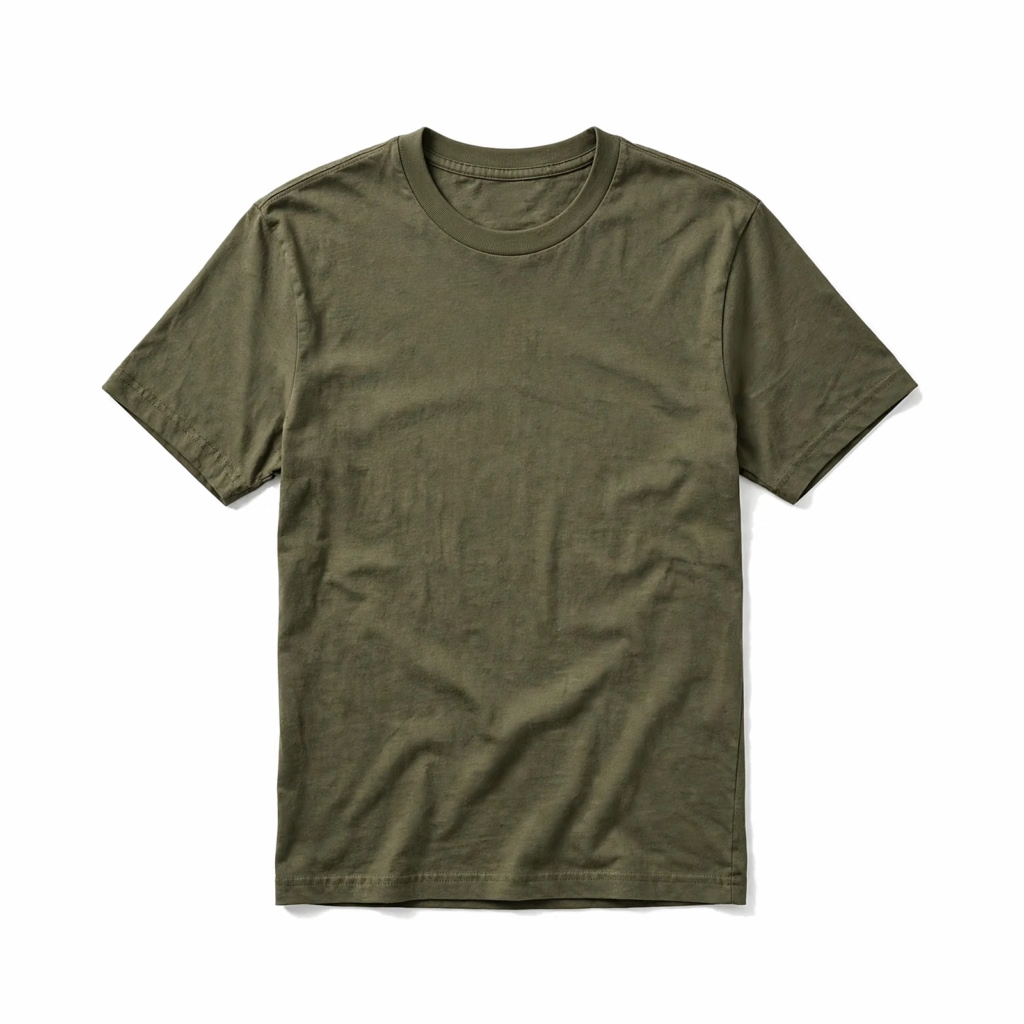
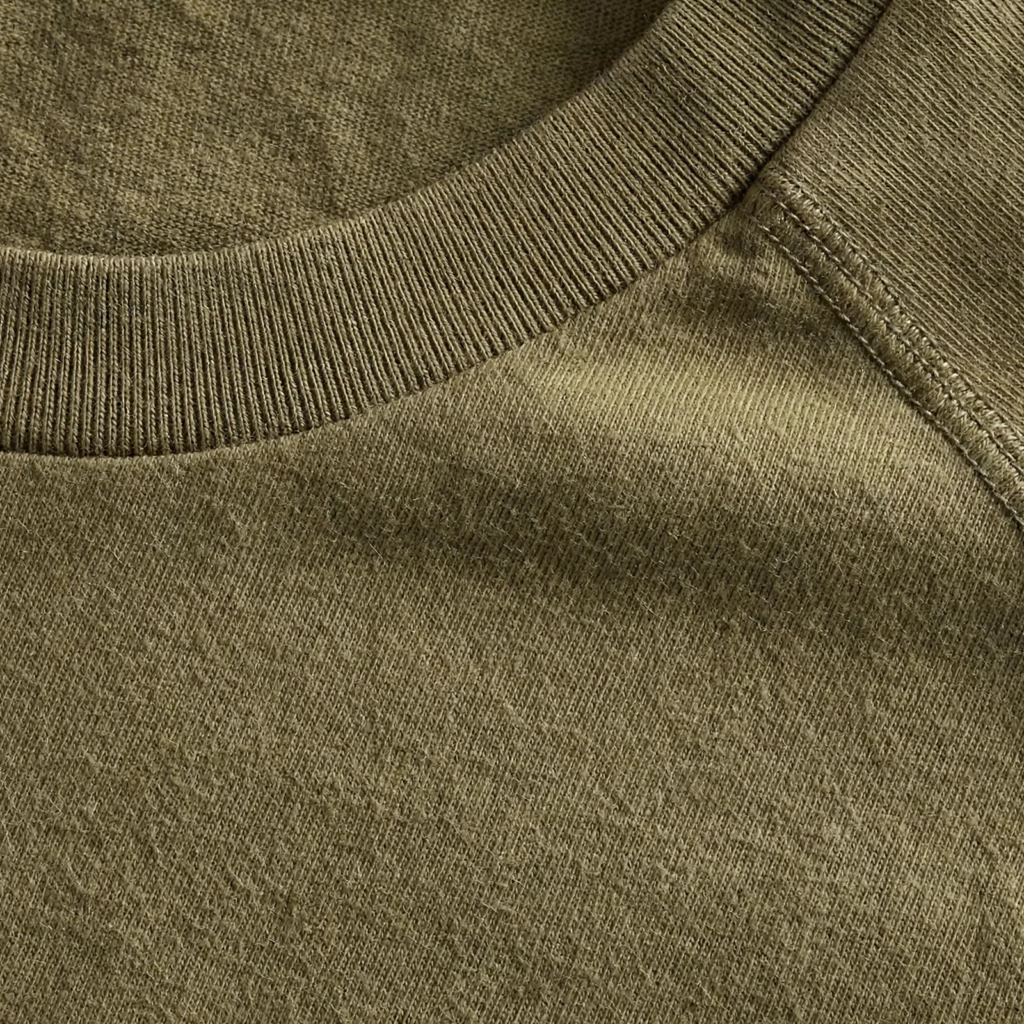
Most shirts in this guide begin as cotton single jersey, the knit pictured on this page in a plain mid olive: a light, breathable fabric with a smooth face that accepts print cleanly and wears comfortably through Kampala heat all year.
Settle the fabric brief yourself instead of accepting a catalogue default: fibre, weight and finish belong in your written instructions and get proven on the trial garment, because hand feel is the first judgement a customer makes when lifting a shirt from a rail.
Shade asks the same discipline as fabric: colours are matched against your standard, checked under plain light before cutting starts, and the passed garment then serves as the colour reference for every repeat, so olive and white ranges hold steady between deliveries over years.
On a basics line, build outlasts decoration: a ribbed crew collar that keeps its shape, taped shoulders, hemmed sleeve ends and a straight flat hem divide a shirt still selling next season from one twisted out of shape by ordinary wear and washing alone.
Printed lines carry one more decision, the print method, and it belongs at trial stage: artwork size, position and colours are fixed on the trial garment, passed by you, then held across the run instead of being adjusted mid production by anyone at all.
Weight is likewise your call: a heavier jersey hangs with more body for a premium basics line, while a lighter knit breathes better for promotional shirts worn outdoors, and the trial stage is exactly where that choice gets proven in your hands before bulk.
Dyeing deserves its own question: ask how the shade is held between the first batch and the fifth, because a colour that wanders between deliveries quietly breaks a range even when every other part of the garment holds steady for your customers season after season.
How Ugandan Buyers Organise a Bulk T-Shirt Programme
Bulk buying in Uganda is several trades sharing one name, and each organises its Bangladesh consignments differently; the companion guide to the top t-shirt exporters to Brazil largest suppliers shows merchants in another market working through the same choices from their own side.
Wholesalers and Market Traders
Stallholders and wholesale merchants buy plain and printed basics across mixed colours and sizes, reorder the fast movers quickly, and need repeat runs landing close enough to the first delivery that regulars spot no difference when they reach for the same shirt again.
Promotion and Campaign Buyers
Buyers feeding campaigns, events and organisations purchase against dates rather than seasons: artwork led shirts in agreed colours, delivered to a calendar, where one late box can empty an entire event and early trial approval is the only real protection available to anyone.
Schools, Faith Groups and Institutions
Uniform buyers, schools, firms and faith bodies among them, want sameness above novelty: a single shade, a single chest emblem and a single size run coming back term after term, so a new joiner stands indistinguishable from members enrolled two years earlier.
For buyers of that kind, tag and packing instructions carry the same weight as the garment itself: sets sorted by size, boxes marked plainly, and papers that let a storekeeper verify a delivery in minutes instead of opening every bale across the floor.
What Decides the Price of a Bangladesh-Made T-Shirt
Your brief is what decides the price, honestly read: fabric fibre and weight, garment build, print size and colours, tag and packing instructions, and the size and shape of the consignment itself, each priced from the paper, never a headline figure invented from air.
That is why two figures for what looks like the same shirt can land far apart: one quietly assumes lighter fabric, looser grading or simpler packing, and only the trial garment, sewn against your paper, reveals which figure described your shirt truthfully all along.
Freight belongs in the same sums from the start: the route chosen, the box packing and the timing all move the landed cost in Kampala, so a serious comparison prices the whole delivered programme rather than the factory gate figure standing on its own.
Merchants who keep that discipline, brief first, trial garment second, price compared across the whole delivered programme, seldom pay twice for the same lesson, and they build maker relationships that outlast a single season of trading in a market as demanding as Uganda.
A quotation, put plainly, is a reading of your paper rather than a number lifted from a catalogue: a vague brief returns a price for a vague garment, while a precise brief returns figures you can defend at the counter in front of anyone.
Consignment shape moves the figure too: a programme spread across many colours and sizes in small lots costs more per shirt than a deep run of one style, which is why the range plan belongs inside the first conversation about price.
Reading a Sample the Way an Importer Reads It
Check the trial garment against your paper item by item: chest width and body length against your size chart, shade against your standard in plain daylight, print size and placement against your artwork, and the tag sitting where your instruction put it.
Then handle the piece the way a shopper will: stretch the collar and see it recover, run it through a wash and recheck shade and shape, and test the seams with a firm tug, because a garment surviving that treatment forecasts the run honestly.
Send every correction back as one written list, and ask for deep changes to be proven on a revised trial garment wherever the alteration runs deep, because approvals remembered from conversation are exactly where sound programmes quietly begin to drift over time themselves.
Keep that passed garment afterwards, tagged and dated, somewhere safe: it becomes your evidence at every repeat order, the piece any disputed box is measured against, and the cheapest insurance a bulk programme in Kampala will ever carry from one season to another.
Frequently Asked Questions
Can a buyer in Kampala order t-shirts carrying its own label and artwork?
Yes, entirely: on a made to order road the maker sews to your brief, prints your artwork and fits your own woven tag, and a trial garment is sewn first for your sign-off before bulk production begins on the consignment you placed with them.
How does a first order with a factory on this list usually begin?
A first consignment opens with papers rather than production: your brief, artwork file and size chart go to the maker, a trial garment comes back for your inspection, and bulk sewing is released only once your sign-off stands recorded in writing first always.
Who arranges the freight and customs side of a Uganda-bound order?
Export papers and packing are readied by the maker to your instruction, while freight and clearance on the Uganda side are arranged by you or your agent, working under the import routine your programme already follows each season of the year without change.
Can one programme mix several colours, styles and sizes together?
Yes, that is the ordinary shape of a programme: several colours and styles are built as one range, each graded across your size chart, trialled style by style and packed to the ratio you set for each export box leaving Bangladesh for Uganda.
What should a Ugandan trader check before settling on one factory?
Three checks predict a season better than any brochure: the trial garment measured against your brief, the maker’s road weighed against your programme shape, and the paperwork habits confirmed in writing before any money moves toward the first bulk consignment you place there.
About This Guide
This guide was assembled for Kampala merchants and buyers across Uganda who bring t-shirts in from Bangladesh and want the factory landscape laid out without decoration, every profile resting on published company information and nothing dressed up or invented along the way.
Siatex stands inside the list it helped to compile, and we are members of the Bangladesh Garments Buying House Association, a fact placed here once, in this closing section, rather than scattered through the profiles where ten factories are being weighed for Uganda.
Start Your Kampala Programme From a Passed Trial Garment
Every road described in this guide to the Top Supplier for Bulk T-Shirt Purchases Kampala Uganda starts at the same place: a trial garment made to your own paper, judged in your own hands before any money moves on the consignment itself at all.
If your range wears your own brief, your own artwork and your own tag, that is precisely the work the made to order road at Siatex exists for, and it opens with a conversation, not an invoice, about the line you want built.
Bring the paper you already have, even if it is rough: a photograph of a shirt you sell, a size chart from a previous consignment and the artwork file are enough for a first trial conversation to begin properly and honestly straight away.
Get a Price for Your Own T-Shirt Programme
Put your brief through our contact page and what comes back is a sampling plan for your range, so the next Uganda programme you run starts from a garment already held in your hands, checked line by line and passed by you personally.