
Custom Hoodies Supplier Manufacturer in Bangladesh Sewing for Japan Programmes
Japan buyers are famous in our trade for reading a garment the way an editor reads a page: nothing is decoration, everything is a decision. A hoodie for that market is not judged by its photograph. It is judged by the inside of its hood, the end of its drawstring and the tenth wash.
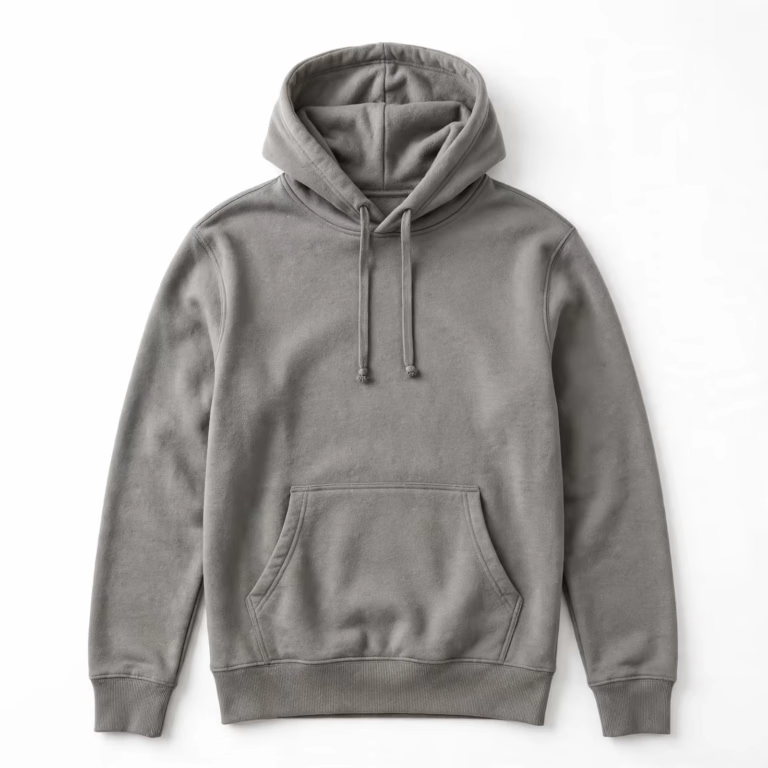
This page sets out the stone grey pullover build we sew for Japan: how the fleece is chosen, how the hood is lined, and how your pattern, colour and grading are held from the first sample to the last carton.
Fleece Chosen for the Tenth Wash
Most fleece looks good on the day it is cut. The question is what the surface does after repeated washing, and that is decided by the yarn and the brushing before a single seam is sewn. Our standard cloth is a cotton-rich brushed fleece with an even, short pile that resists the shiny patches cheap fleece develops.
The stone grey shade is read under daylight lamps against your approved swatch. Grey is an unforgiving colour: a half-tone drift shows across a rail of hoodies, so colour is checked panel by panel, not only roll by roll.
Weight and Hand-Feel
The standard weight suits the Japan season from autumn into spring. Lighter and heavier cloths run on the same pattern, and the hand-feel of the approved sample is the reference every lot is compared against, by hand and not only by scale.
The Hood, Lined and Balanced
A hood tells the truth about a hoodie. Ours is lined, so the inside a wearer sees is fleece, not raw seams, and the crown is shaped so the hood sits centred instead of drifting to one side.
- Lined hood with a clean centre seam, finished so nothing rubs the neck.
- Drawstring in matched cord, ends finished to your spec, knotted or tipped.
- Neckline taped, so the hood’s weight never stretches the collar out of line.
Drawstring length is a measured spec on this programme. Too long reads careless, too short disappears into the casing, and Japan buyers notice both, so the length is set from your sample and checked on every size.
The Kangaroo Pocket, Sewn Square
The pocket is the most-touched part of a pullover hoodie, and the part most often sewn crooked elsewhere. Here it is positioned from measured points, stitched flat, and bar-tacked at the mouths where hands pull it daily.
The pocket opening is sized to your pattern. Where a programme wants a hidden phone sleeve inside the pocket, it is added on the same build and sampled first.
The Build Sheet
Ribs and Recovery
Cuffs and hem are ribbed with enough recovery to gather the sleeve and waist after a year of wear. A loose cuff is the first visible age mark on a hoodie, so rib quality is checked by stretch and release on the line.
Seams and Pressing
Seams are sewn flat and even, and every hoodie is pressed before folding. The fold itself follows your retail standard, so the garment your stores unpack is already the garment they meant to display.
Your Label at the Back Neck
Your woven label sits inside the back neck, sewn flat into the taped seam. On a Japan programme the label is part of the finish the wearer inspects, so its position and stitching are checked like any other visible detail.
Care and fibre text is printed in Japanese where your programme requires it, with the content stated exactly as the cloth is made. Size markings follow the Japan system on your chart.
Checks Before the Cartons Close
Every lot is measured against your chart and read against the approved sample: hood balance, pocket position, drawstring length and colour, size by size.
- Hoods compared in pairs for centring and lining finish.
- Pocket position measured, never judged by eye alone.
- Colour read panel by panel under daylight lamps.
- Wash check on finished hoodies, including cuffs and hem recovery.
Samples Judged the Hard Way
The sample is sewn in your colour, with your label and your drawstring spec, and it is meant to be judged hard: washed, worn and inspected inside out. A Japan programme that passes that test does not surprise anyone later.
If a detail needs to move, it moves on the sample. Bulk cloth is never cut against an unapproved change, and the approved sample stays on file as the reference for every reorder.
Grading on the Japan Chart
Japan grading is its own discipline: the steps between sizes are finer than Western charts, and the body length sits differently. We grade to your chart exactly, keeping the hood, pocket and rib proportions honest at every size.
Women’s and unisex fits run on the same programme as their own patterns. A smaller size is never a shrunk men’s block; the shoulder, body and sleeve are graded as the fit intends.
Reorders That Match the First Delivery
A hoodie programme lives on reorders, and a reorder must match: same grey, same pile, same drawstring hand-feel. Your approved sample, pattern and measurements stay on record, so a repeat order is sewn against the original reference, not against a memory.
When your range adds a colour or a print, the change is sampled on the same build first, and the original spec stays on file until you retire it.
Packing and Presentation for Retail
A hoodie sold in a Japan store is handled before it is worn, and the fold is part of the product. Folding follows your retail standard, with the label and size marking visible where your stores expect them, and each garment protected for the journey.
Cartons are packed by size and colour in your ratio, marked in your system, so a store or warehouse can check a delivery against the order without opening every box. Where your programme sells online, the same garment is prepared for individual dispatch under your rules.
A Note on Seasons
Japan programmes plan by season, and the hoodie sits in more than one of them. The standard fleece carries autumn and spring on its own and layers through winter, which is why the fit leaves room underneath without turning loose.
Where a range runs a lighter summer hoodie and a heavier winter one, both are sewn on the same programme discipline: same label position, same drawstring standard, same grading logic, so the wearer meets one brand across the year.
Questions Japan Buyers Ask
Can the hoodie carry a chest print or embroidery?
Yes. Print and embroidery positions are set from your artwork and sampled on the fleece first, because fleece takes ink and thread differently from jersey, and the sample shows the true result.
Do you sew to a supplied pattern?
Yes. A supplied pattern is followed exactly, and any point where the pattern and the cloth disagree is raised before cutting, never solved silently on the line.
How is colour consistency held across a large order?
Cloth is approved roll by roll against your swatch, panels are read under daylight lamps, and shade grouping is kept through sewing so one carton never mixes two tones of grey.
Start Your Japan Hoodie Programme
Send your pattern, colours and size chart through our contact page. We will make it at your level: your quality, your fabric, your design, your measurement, and your hoodies will arrive ready for the closest inspection in the trade.
Uniform buyers on the same programme standards can see our custom logo polo shirts, and workwear buyers our professional workwear manufacturing page. Market background on Japan apparel imports is published by the International Trade Centre.