
Custom Mens Grey, Cream Red Panel Shirt Manufacturer in Bangladesh for Colour-Block Ranges
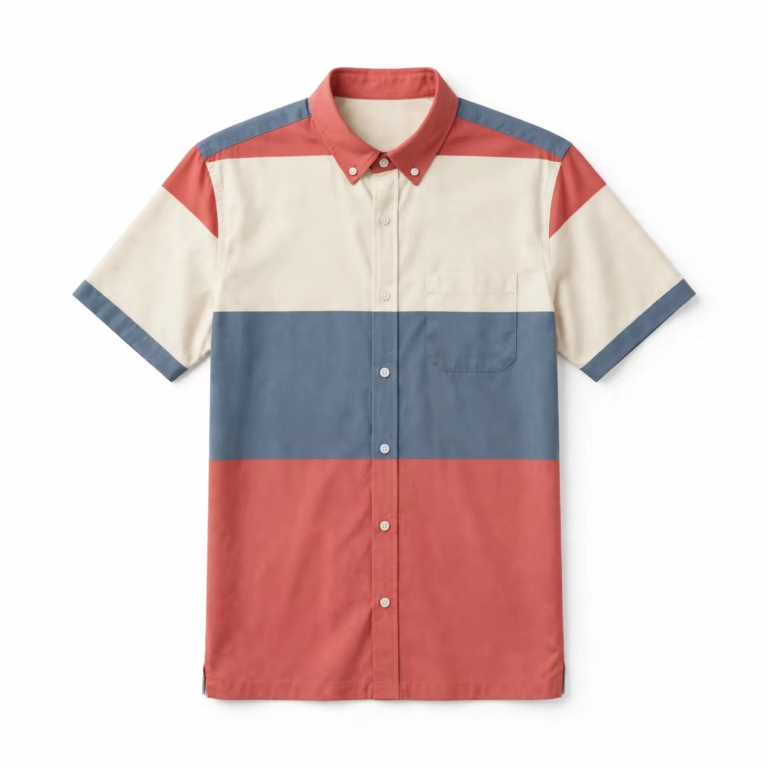
Some shirts are bought for their pattern and some for their colour story, and this one is firmly the second kind: three broad horizontal bands, cream, blue-grey and salmon red, cut straight across a short-sleeve shirt.
Siatex makes it in Bangladesh for brands running colour-block stories in their casual shirting. The band heights, the three cloth colours, the collar colour and the grading all follow your specification.
Three Bands, Cut Straight
The body is built from three broad straight horizontal bands: cream across the upper chest, medium blue-grey across the middle, and muted salmon coral red from the lower abdomen to the hem. The seams are dead straight, which is what makes the design read as deliberate rather than decorative.
Band heights are a sampling decision with real consequences: move the first seam two centimetres and the whole proportion changes. The heights are fixed on the approved sample and held by template, so every size keeps the same visual rhythm.
Shoulder Caps and Sleeve Wedges
The detail that lifts the design sits at the shoulders: a small blue-grey cap at the very top of each shoulder, a red band below it across the upper chest, and red wedges on the upper outer sleeves where they join the body.
Those pieces are cut and joined with the same care as the bands themselves, because a wedge that sits a few millimetres off shows at once. The shoulder assembly is checked on the first garment of every size before the run proceeds.
A Red Button-Down Collar
The collar is a button-down in the salmon red, with a small white button at each point. Taking the collar from the hem band’s colour ties the design together top to bottom, and the buttoned points keep the casual shirt’s collar sitting flat and tidy.
Collar colour is yours to assign at sampling: red, grey or cream all work on this block, and the choice changes the shirt’s mood without touching the pattern. The approved assignment is recorded and held across reorders.
Buttons in White, On Purpose
The straight centre placket fastens with white buttons, the same white as the collar points. Against three band colours, white is the neutral that belongs to all of them, and it keeps the front reading clean at every seam crossing.
Button size and spacing follow your specification. Where a button lands close to a band seam, its position is set so the seam and the button never fight: the spacing is planned on the sample, not discovered on the bulk.
A Pocket Across the Seam
One plain patch pocket sits on the wearer’s left chest, and it straddles the cream and grey seam: its upper part is cream, its lower part grey. That crossing is the design’s quiet signature, the detail a buyer notices second and remembers.
Making it work takes exact cutting: the pocket’s two cloths must join at the same height as the body’s seam on every garment. The pocket is cut as one piece from the two bands and placed by template, then checked against the seam line.
Short Sleeves, Grey Opening Bands
The sleeves are short, ending above the elbow, mainly cream with the red wedge at the top and a narrow blue-grey band at each opening. The grey band closes the sleeve the way the grey middle band closes the body’s colour story.
Sleeve length and band width follow your specification. The opening band is cut in the middle cloth, so the three colours appear on every part of the shirt and no panel is left as a one-off.
A Straight Hem With a Small Slit
The hem is essentially straight across, in the red band, with a small side slit that lets the shirt move when it is worn untucked. The body is hip length, cut to be worn out over trousers or shorts.
Slit depth follows your specification. On a panel shirt the hem finish matters more than usual, because the eye travels down the bands and lands there: the stitching is kept even and the slit is bar-tacked to hold.
A Regular-to-Slim Fit
The fit is regular-to-slim, close without clinging, with the body falling straight from chest to hem. Panel designs punish a sloppy fit, because every seam is horizontal and any drag shows as a crooked line.
Each size is graded on your chart and the sample set is checked across the run, with the bands’ straightness part of the fit check. Your comments at sampling govern the final block.
The Bands Continue at the Back
At the back the three bands continue around at the same heights, below a yoke in the cream, with the red collar above. The design reads from behind exactly as it reads from the front, which is what a colour-block shirt owes its wearer.
Band alignment at the side seams is a named check: the seams must meet level around the body. A panel shirt whose bands step at the sides fails its own idea, and the check is made before packing, not after a complaint.
Your Label Under the Red Collar
Inside the back neck, below the red collar, your own woven label is sewn in your artwork. In our pictures it reads YOUR LABEL, because that space carries your brand and your care wording.
On a design-led shirt the label is where the buyer’s brand signs the garment. Artwork, size marking and placement are approved at sampling and held exactly across every reorder.
Fine Woven Shirting, Matte
The cloth is a fine woven shirting, matte, light to medium in weight, with a slight texture that shows most in the grey and red panels. Three cloths in one garment means three dye lots to agree on, and the agreement is made at sampling against your colour references.
Because the panels sit side by side, shade agreement matters more here than on a plain shirt: the bulk is checked panel against panel under the same light as the approved sample before cutting proceeds, and any lot that disagrees with its neighbours is held back rather than sewn.
Made in Bangladesh, Panel by Panel
Production runs in our own Bangladesh lines, where panel work is a daily discipline: bands cut to template, seams sewn straight, pockets crossed at the seam, collars buttoned down evenly, and a press that keeps the matte cloth soft.
Bangladesh gives the order its depth of shirting skill and its honest cost base. The first garment of every size is checked against the approved sample for band heights, fit and finish before the run is packed.
Sampling a Panel Shirt
Sampling starts from your three colour references, your band heights and your size chart. The first sample is checked for seam straightness, pocket crossing and collar colour, photographed, and sent for your approval.
Corrections are made and re-approved before bulk cutting starts. Buyers can stock this shirt beside the other colour stories in the same catalogue, building a casual wall where each design is sampled with the same discipline.
Companion Shirts From the Same Bench
For a checked option, the Custom Men’s Soft Beige Check Shirt covers the quiet end of the wall. The Custom Men’s Blue, White and Yellow Check Shirt brings the bold windowpane.
The Custom Men’s Light Blue Stripe Half Sleeve Shirt covers the short-sleeve stripe slot. Trade data for your target markets is published by the International Trade Centre.
What Buyers Ask About the Panel Shirt
Buyers ask whether the bands stay level at the side seams in bulk. They do, because the band heights are templated and the side-seam match is a named check on the first garment of every size, not a hope left to the sewing line.
They also ask whether three cloths complicate reorders. The colours are recorded as approved references and held in the order file, so a reorder is a cutting instruction, not a new colour negotiation.
Where a Panel Shirt Sells
Colour-block shirting sells in casual and resort ranges, in holiday capsules, and anywhere a rail needs a shirt that reads from six metres away. The cream, grey and salmon story sits in the warm, muted register that photographs well and wears easily.
It is a design with a long memory in menswear: bands return every few seasons, and a buyer holding a proven block when they return is ahead of the market rather than chasing it.
Washing Three Cloths
The shirt washes cool with similar colours; the three cloths are the same shirting quality, so they shrink, press and age together rather than pulling against each other. That sameness is specified at sampling, not assumed.
Care wording is yours to set on the label. The wash behaviour is confirmed on the approval sample, so the instructions your customers read are the ones the garment was tested against.
Packing a Colour Story
Each shirt is folded with the bands showing in their order, collar points buttoned, so the colour story is visible the moment the polybag opens. Cartons follow your size ratios and markings, and mixed orders across the shirting catalogue are packed to your split.
On a panel shirt, consistency is the product: the fiftieth shirt out of the carton must carry its bands at the same heights as the first. The pack check is made against the approved sample before cartons close.
Colour Agreement Across Three Dye Lots
The unglamorous heart of this garment is colour agreement: three cloths, three dye lots, one shirt. Each lot is approved against the buyer’s reference and then against its neighbours, because a grey that is right alone can be wrong beside the cream.
That is why the sampling round for a panel shirt takes the time it takes. Once the three references are locked together, bulk and reorders run from the locked set without reopening the question.
Recolouring the Same Block
The block takes other colour stories without a new pattern: a sand, stone and rust story for autumn, a sky, white and coral story for high summer, or the buyer’s own three references matched to cloth. Each story is sampled as a set, because the agreement between the three cloths is the product.
That makes the panel shirt a platform rather than a one-season design. A buyer can run the same proven fit through several colour stories in a year, each sampled once and reordered from its locked references, which is how colour-block ranges are built to last season after season without fresh development cost or fresh fitting risk for the buying team to carry each time.
Start Your Panel Shirt Order
Send your size chart, your three colour references and your label artwork, and the first sample comes back for your approval before any bulk cutting. The block is proven, the bands are templated, and the line is ready.
That is how Siatex works as your manufacturer in Bangladesh: your level, your quality, your fabric, your design and your measurements, sewn into a colour story your buyers can build a wall around. Reorders run from your approved sample and stored grading, so the tenth order matches the first at every size.