
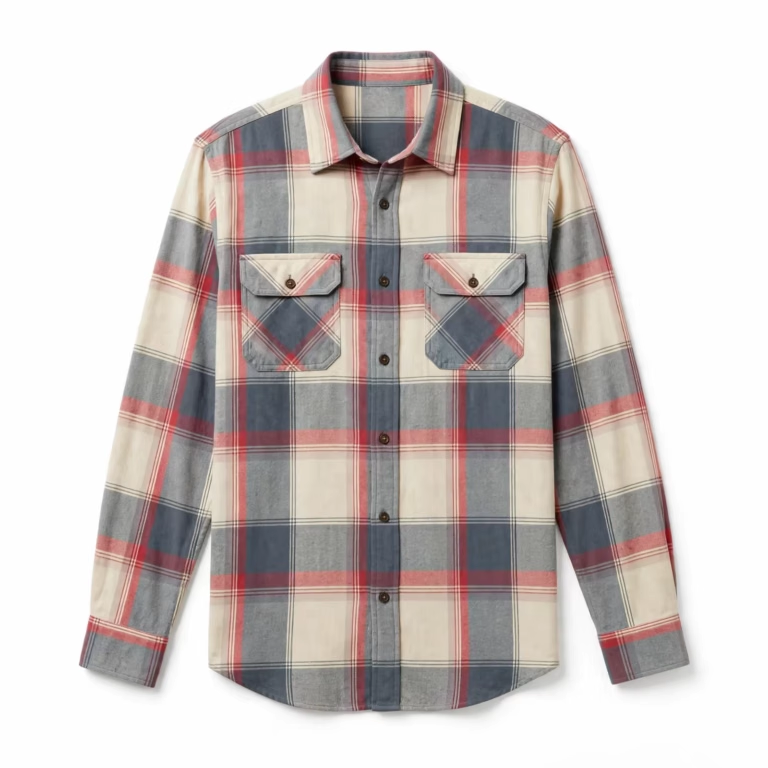
Custom Mens Soft Beige Check Shirt Manufacturer in Bangladesh for Quiet Everyday Shirting
Not every shirt in a range should shout. This one is a fine mini-check on a soft beige ground, the kind of shirt that sells steadily in every season because it goes with everything a customer already owns.
Siatex makes it in Bangladesh for brands whose shirting walls depend on exactly this kind of dependable pattern. The check scale, the button colour, the collar and the grading all follow your specification.
A Mini-Check in Soft Beige
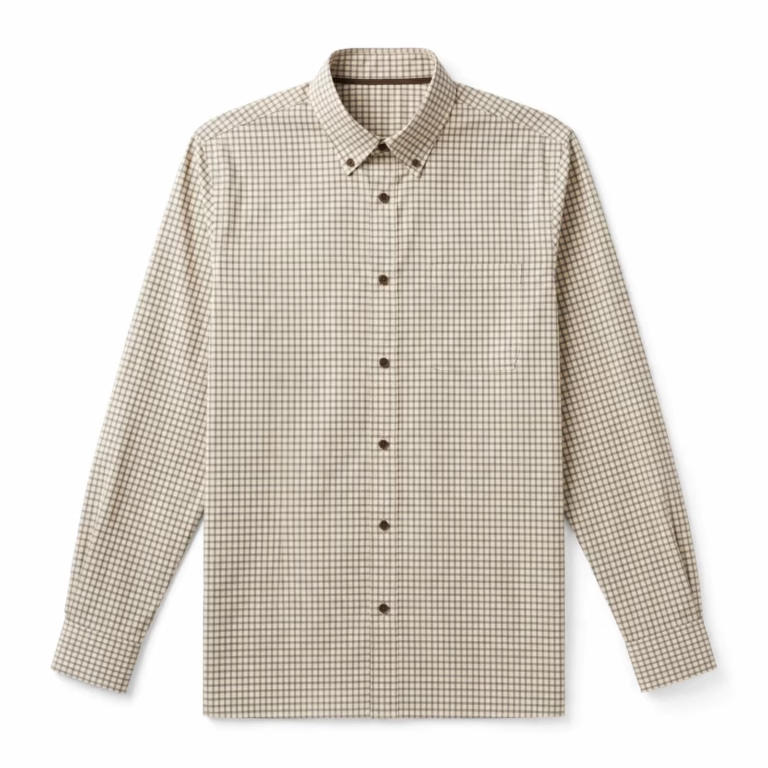
The pattern is a fine, uniform mini-check covering the whole garment: thin muted grey-brown lines and paler cream-white lines crossing both ways on a pale soft beige ground, in small even squares with slightly darker intersections. There is no windowpane and no bold over-check.
Small checks live or die on regularity: a wandering line shows at once across a chest. The cloth is woven to an even repeat and checked across the roll, so the grid on the hundredth shirt matches the grid on the first.
A Button-Down Collar in the Same Check
The collar is a button-down point collar in the same mini-check, held by a small dark-brown button at each point. Button-downs keep their shape without a tie, which is why this collar suits the shirt’s everyday character.
Inside the top of the collar band runs a narrow dark-brown strip, a quiet detail that ties the collar to the buttons. Collar shape, point length and button placement are approved at sampling and held across the run.
Dark-Brown Buttons Down the Placket
The placket is cut in the same check with no contrast strip, and fastens with six small dark-brown buttons. Against the pale beige, the brown reads warm and deliberate, the one stronger note in an otherwise soft design.
Button colour is a small decision with a long shadow: it sets the shirt’s tone on the rail and in the photograph. Brown, horn-effect or self-colour options are sampled so the buyer chooses with the cloth in hand.
One Open Pocket, Pattern Matched
There is one chest pocket, on the wearer’s left: a flat rectangular open patch pocket with no flap and no button. Its check is matched to the body, lines running through in the same direction, so the pocket sits quietly in the pattern.
Matching a mini-check across a pocket is fiddly work, and it is where cheaper shirts give themselves away. Here the match is a production standard, checked on the first garment of every size.
Full Sleeves, Plain Barrel Cuffs
The sleeves are full length and plain, ending in single-button barrel cuffs with a small sleeve placket and button above each cuff. They are cut to hang straight and clean, the way the shirt is photographed and the way it is worn.
Cuff width, placket length and button size follow your specification. On a quiet shirt these small proportions matter more, not less, because there is nothing else to distract the eye.
An Essentially Straight Hem
The hem runs essentially straight across with only the slightest curve, a shape made to be worn untucked as readily as tucked. The body is long, to hip length, so it stays in place when it is tucked.
Hem shape is set at sampling: straight, gently curved or a fuller shirttail are all cut from the same block. The approved shape is then held across every size in the grading.
A Regular Fit With Natural Shoulders
The fit is regular and straight, with no waist shaping and natural, slightly sloping shoulders. It is the forgiving middle of shirting: neat on most bodies, comfortable all day, and easy to grade.
Each size is graded on your chart and the sample set is checked across the run, not only at the middle size. Your fit comments at sampling govern the final block, and the block is then frozen for reorders.
A Yoke and Centre Pleat Behind
The back carries a yoke across the shoulders with the mini-check continuing, and a centre pleat below the yoke that gives the wearer room across the blades. The check runs through the yoke seam without a break in its rhythm.
A pleat is a working detail, not decoration: it is the ease that lets a regular-fit shirt reach and bend without pulling at the buttons. Its depth is set at sampling and checked on the worn sample.
Your Label Below the Brown Strip
Inside the back neck, below the dark-brown collar strip, your own woven label is sewn in your artwork. In our pictures it reads YOUR LABEL, because that space carries your brand and your care wording.
On a quiet shirt the label is the loudest branding there is, which raises its value. Artwork, size marking and label placement are approved at sampling and held exactly across every reorder.
Made on Our Bangladesh Lines
Production runs in our own Bangladesh facilities, where fine shirting is sewn daily: collars set cleanly, button-down points sitting flat, pockets matched by hand-checked placement, and a press that leaves the matte cotton soft rather than glazed.
Bangladesh gives the order its depth of shirting skill and its honest cost base. The first garment of every size is checked against the approved sample for check match, shade and fit before the run is packed.
Sampling a Quiet Check
Sampling starts from your check reference, your cloth weight and your size chart. The first sample is checked for grid regularity, pocket matching and collar shape, photographed, and sent for your approval.
Corrections are made and re-approved before bulk cutting starts. Buyers can stock this shirt beside the bolder checks in the same catalogue, building a shirting wall where the quiet patterns carry the steady volume.
Shirting Neighbours in Beige and Blue
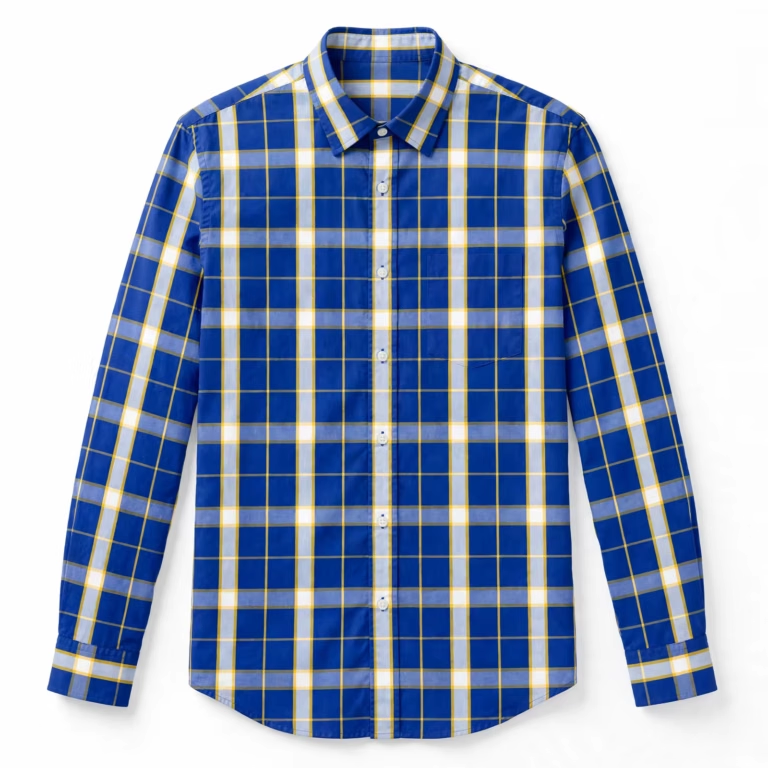
For a bolder grid, the Custom Men’s Blue, White and Yellow Check Shirt carries the large windowpane. The Custom Men’s Royal Blue with Lemon Check Shirt brings the strong blue ground.
The Custom Men’s Light Brown and White Check Shirt offers the fine tattersall in warm browns. Trade data for your target markets is published by the International Trade Centre.
Questions Buyers Ask About the Beige Check
Buyers ask whether a check this fine reads as a pattern or as a plain at rail distance. Honestly, both: from across a shop it reads as a soft textured beige, and the grid rewards a closer look, which is exactly the behaviour that makes mini-checks such steady sellers.
They also ask about the pocket match on reorders. The matching standard is written into the production file with the approved sample, so a reorder is matched against the same reference as the first run.
Where a Quiet Shirt Sells
This shirt’s markets are the everyday ones: office-casual programmes, uniform-adjacent ranges where a soft pattern is allowed, and retail walls that need a neutral to rest the eye between stronger pieces. Its softness is its commercial strength.
It also travels well across age groups, because nothing in it dates. A buyer building a long-running core range, rather than a seasonal story, is exactly who this pattern serves.
Washing a Fine Cotton Check
The shirt washes cool with similar colours and keeps its grid through washing, because the check is woven, not printed: there is no surface layer to crack or fade unevenly. The matte finish stays matte.
A light press restores the collar and cuffs; the cloth itself needs little. Care wording is yours to set on the label, and the wash behaviour is confirmed on the approval sample.
Packing a Soft Pattern
Each shirt is folded with the collar buttoned down and the pocket visible, so the first thing a customer sees is the pattern sitting correctly. Cartons follow your size ratios and markings, and mixed check orders are packed to your split.
On a quiet garment, presentation carries more weight: a crooked collar or a wandering grid line is the whole story. The pack check is made against the approved sample before cartons close.
The Grid, Woven Not Printed
Because the check is in the weave, it has a slight texture under the hand that a print cannot imitate, and the intersections where the darker lines cross give the cloth its depth. Customers feel the difference before they can name it.
That woven quality is also why the shirt photographs honestly: what the camera sees is what arrives. Our set is shot plainly, lit evenly, with the grid at its true scale.
Check Scale, Chosen Deliberately
Mini-check is a family, not a single pattern: halve the square size and the shirt reads almost plain; double it and the grid becomes the design. This shirt sits at the fine end, where the pattern behaves like a texture, and that position is a deliberate choice the buyer confirms at sampling with the cloth in hand.
We weave or source the grid to your reference photograph or physical swatch, and the approval sample fixes the scale for production. A millimetre of drift changes the shirt’s whole character, so scale is treated as a specification, not an approximation.
Interlining That Keeps the Collar Soft
A button-down collar should roll softly, not stand like cardboard. The interlining weight is chosen to hold the points down under their buttons while keeping the collar’s natural curve, and it is fused to survive washing without bubbling.
Buyers who want a firmer, more formal collar can specify it at sampling; the same pattern takes a stiffer interlining cleanly. The choice is recorded in the production file so reorders match.
A Neutral That Anchors a Range
Soft beige is the neutral warm end of a shirting range, and it anchors the stronger colours around it: rails photograph better, and customers building an outfit find the piece that lets the rest work. Ranges without a quiet anchor often sell their loud pieces more slowly.
That is the commercial case for a shirt like this in every programme: it rarely tops the weekly chart, and it is almost never the piece left over at the end of the season.
Buttons Chosen to Last
The dark-brown buttons are sewn with a shank that lets them sit flat over the placket layers without pulling, and each is checked for cracks and colour consistency before it reaches the line. A spare button is sewn inside the side seam of every shirt, in the same brown, so a lost button never orphans the garment.
Small mercies like that are what separate a core-range shirt from a disposable one, and they cost almost nothing when they are planned into the production file from the start rather than added as an afterthought.
Start Your Beige Check Order
Send your size chart, your check reference and your label artwork, and the first sample comes back for your approval before any bulk cutting. The pattern is proven, the cloth is light and clean, and the line is ready.
That is how Siatex works as your manufacturer in Bangladesh: your level, your quality, your fabric, your design and your measurements, sewn into a quiet shirt that sells by being easy to wear with everything. Reorders run from your approved sample and stored grading, so the tenth order matches the first at every size.