
Wholesale Sweaters Manufacturer in Bangladesh for Guyana
Guyana’s importers and retailers bring knitwear into a warm country where a sweater earns its place in air conditioned offices and shops, on cool rainy season evenings and in the travel trade. Every sweater on the rail must match its neighbour, so Siatex knits each order new in Bangladesh.
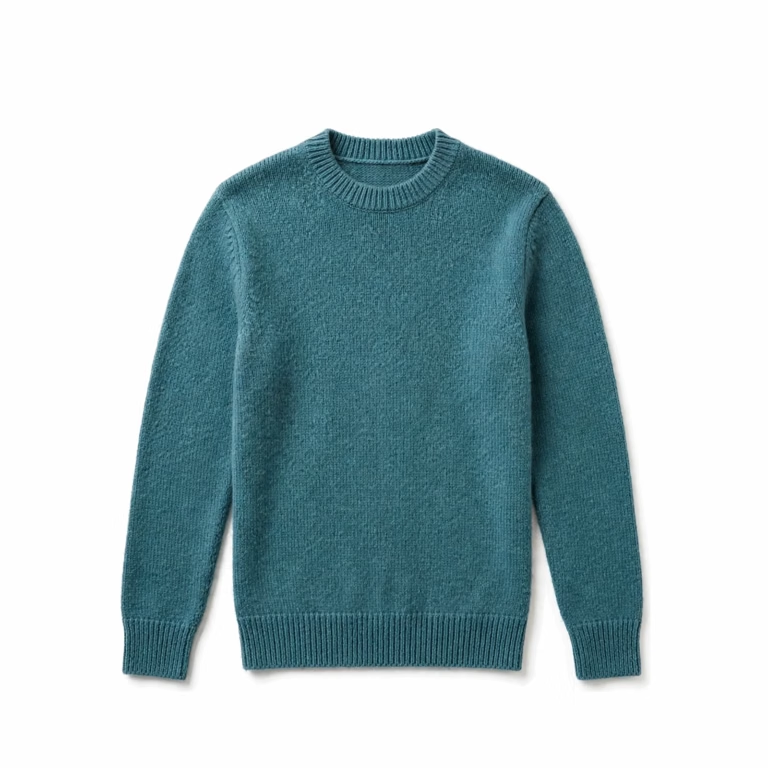
The sweater in the gallery is a men’s crew neck in mid teal, size L, knitted in a plain stitch at a comfortable gauge, its yarn texture easy to read in the hand. Ribbed bands finish the collar, the cuffs and the hem, and nothing decorates the body at all.
Knitted New Against Your Written Specification
Production begins with your document, never with a ready pile of knitwear. The specification you send fixes the yarn, the gauge, the teal, the sizes and the label before a single panel is knitted, and the floor works to that document from the first cone to the last carton.
Each stage answers to the same sheet. The knitters follow your pattern, the linkers follow your construction notes and the packers follow your carton plan, so what arrives in Georgetown is the garment you described, row for row, not a near version pulled from somebody else’s programme.
Mid Teal Yarn, Stitch Readable in the Hand
Plain knit rewards a close look. From a step away the body reads calm and even; picked up, the stitch shows its structure and the yarn shows its fibre, which is how a customer in a Georgetown shop decides whether a sweater is worth the price on its ticket.
Tone is guarded just as closely. Body, sleeves and trims hold the same mid teal from shoulder to hem, with no panel drifting lighter or deeper than the next. Incoming yarn is checked for evenness, cleanliness and wash behaviour, and only yarn that passes is wound for knitting.
- Yarn, gauge and weight settled inside the buyer’s specification
- Body, sleeves and trims knitted from a single dyed yarn lot
- Stitch and fibre texture readable at natural viewing distance
- Buyer’s colour reference matched before any knitting begins
Ribbed Bands Linked Stitch to Stitch
The collar is a ribbed band linked into the neckline stitch by stitch, so the join lies flat and the band springs back after every wash. Its recovery is tested on the sample, because a collar that slackens early makes the whole sweater look tired long before its time.
The same rib closes both cuffs and the hem, tensioned to keep the sweater’s outline tidy without gripping the wearer. Cuffs finish level with the hem band, and the sleeves rest straight and close against the body, exactly the way the gallery photographs show them lying.
A Bare Body Ready for Your Own Branding
Look across the body and sleeves and you will find no decoration at all: no print, no embroidery, no mark, no lettering anywhere. That emptiness is deliberate. The sweater waits for your label and your branding, or it can go straight onto your rails in Guyana exactly as it stands.
Marks beyond the label earn their place on the sample before anywhere else. Whatever you plan, a woven badge or a chest embroidery, is produced on the sample garment in this teal at this gauge, and bulk waits for your approval of that sample, the route taken by our wholesale sweaters for Panama buyers.
One Teal Held From First Sample to Final Carton
Teal punishes careless dyeing: pushed too green it turns harsh, pushed too blue it turns cold. The target shade is therefore agreed before knitting starts, taken from your reference, your swatch or a sweater kept back from an earlier order, and the dyer answers to that target alone.
Inside one order there is one dye lot only. Body, sleeves and trims are all knitted from yarn dyed in the same run, so two sweaters hanging side by side cannot argue about colour. The shade is read under steady light twice, at sample judgement and again when bulk knitting opens.
- Target shade fixed from the buyer’s reference before knitting
- One dyed yarn lot feeding body, sleeves and trims
- Shade read under steady light at sample and bulk stages
- Approved sample retained as the target for repeat orders
Gauge and Weight Decided by the Buyer
Warmth is chosen at the specification desk, not discovered on a customer’s shoulders. A buyer dressing office staff in cooled interiors names a lighter, airier gauge; a buyer dressing rainy season rails names a denser knit with more body. The sample is knitted at whichever weight you choose.
The fibre blend is yours to write as well. Give the recipe your market prefers and the yarn is spun and dyed to it; the sample then demonstrates how that blend behaves in the wash, across the surface and out of a fold, while the recipe can still be changed freely.
Sizes Graded From Your Own Measurement Chart
Grading here follows one document only: yours. The figures your shops fit customers against, chest, body length, shoulder and sleeve among them, are graded size by size from your numbers, and every grade is knitted and measured before the run is allowed to move past it. No house table interferes.
Look at the gallery and the chart’s effect is visible: a men’s size L with natural body length and sleeves ending where working sleeves end. If your fit runs relaxed, widen the chest on the chart; a fresh sample then demonstrates the new grade long before bulk knitting follows it.
The Sample Is Judged Before Bulk Is Knitted
One sweater is completed first on every order, knitted in your yarn, dyed to your teal, graded to your sizes, laundered and sent to you for judgement. The production run stays waiting while it travels; only your written approval releases it, and nothing is knitted ahead of that word.
Once approved, the sample becomes the order’s reference standard. Yarn, shade, gauge, trims and measurements are checked back against it as finished sweaters come off the line, and anything wandering from it is pulled aside. Request a change and it returns to sampling and judgement before bulk resumes.
Linking and Seams Examined One by One
The linking table decides how the finished sweater hangs. Shoulders out of balance twist the body; a collar creeping off centre makes the neckline look sloppy; a side seam off its course breaks the silhouette. Every one of those points is checked on the garment before it may travel further.
The reverse side is examined with equal care. Each linked join is followed stitch by stitch in search of a skip or a weak place; allowances are pressed flat so nothing ridges against the wearer’s skin; stray ends are snipped off before folding begins.
Checks Placed Along the Whole Knitting Route
Inspection is spread along the route rather than saved for one final look. Yarn is examined when it arrives; knitted panels are examined again before linking; finished sweaters are examined from collar to hem against your approved sample and your chart before a single carton is sealed.
Failure at any reading means the piece goes no further. Whether the fault is a dropped stitch, a shade slipping away from standard or a seam straying off line, the panel returns and is reknitted from sound yarn; a defect waved through here becomes a garment handed back at your counter.
- Incoming yarn examined for shade and surface quality
- Knitted panels checked for stitch faults before linking
- Finished sweaters measured against the buyer’s chart
- Final inspection covering collar, seams and cleanliness
Your Label Sewn Inside the Back Neck
The only name this sweater carries sits inside its back neck: yours. Your woven label is sewn there during making, in the position the gallery’s label view shows, and the same artwork can run onward onto hang tags, poly bags and carton faces without any second instruction from you.
Getting the label ready asks little of you. Send the artwork file with your enquiry; if no artwork exists yet, the words alone are enough, and the lettering is set here, returned to you as a proof and sewn only on your approval. The sample arrives wearing the real label.
Packing Written Into the Specification
How the order travels is decided while the garment is decided, not improvised over open cartons. The fold, the bagging, the count per carton and the printing on the carton face are all written into your specification, and finished cartons are tallied against that sheet before release.
Every one of those choices stays with the buyer. Bag each sweater or fold it open, keep sizes in separate cartons or mix them, print the board or leave it plain: your decision, recorded beside the garment details, so packing day runs on instructions instead of improvisation.
Wholesale Sweaters Supplier in Bangladesh for Germany Importers
German importers buy knitwear under agreements that stretch across seasons, and an agreement survives only when the tenth delivery matches the first in shade, gauge and measurement. Your approved sample is filed as the standing reference, and each later delivery is measured against it before being released.
The gallery shows what that discipline looks like in cloth: one yarn, one collar shape, one rib and seam plan, graded through all sizes on your chart. Sampling is scheduled ahead of the selling season, so knitting happens in calm weeks rather than in a late scramble.
Wholesale Sweaters Exporter in Bangladesh for Canada Retailers
Canadian retail buyers judge a plain sweater at the rail and in the hand. It must look calm beside their own branded pieces and feel worth its ticket when a shopper lifts it. This teal knit meets both tests, offering a readable stitch, a flat lying collar and trims that hold their line.
Retailers often widen the same order book into other markets and categories, handled under the identical discipline of written specification, sample first and approval before bulk. Our wholesale sweaters for Hungary programme runs that way, each market’s production held to its own agreed standard through to the sealed carton.
Wholesale Sweaters Wholesaler in Bangladesh for Netherlands Distributors
Dutch distributors place knitwear with retailers and catalogue sellers whose customers wash hard, wear often and return freely when making disappoints. Against that treatment the sweater relies on even shoulders, tight linking and yarn with real shape memory, and its sample is laundered before approval, exposing any weakness while correction is still inexpensive.
A distributor’s trust is earned on the second order, not the first. When yours lands, the knitting starts again from your filed specification and approved sample, following the size curve and colour range the new season asks for and holding the standard you passed, with nothing pulled from ageing warehouse shelves.
More Markets Served From the Same Floor
Beyond the markets named above, the route reaches further. Orders also leave for France, Belgium, Denmark, Sweden and Norway in Europe, for Chile and Brazil across the Atlantic, for Malaysia and Hong Kong in Asia, and for New Zealand in the Pacific, each one knitted to its own specification.
The floor treats every destination alike. A chain buying under its own label and a trader buying for resale share one queue and one sample gate; what separates their orders is paperwork, plus the single choice of whether this teal body travels blank or carries the buyer’s mark.
Why Guyana Buys Its Knitwear From Bangladesh
Guyana’s shoppers reach for a sweater against the chill of air conditioning, on wet season evenings and before travelling to cooler countries. Bangladesh meets that demand with deep knitwear experience, careful hand finishing and yarn costs that keep a durable, honest sweater at a workable price on the rail.
Distance is planned for, not worried about. Sample dates are fixed first, knitting is booked against your selling season rather than against hope, and the cartons leave counted, packed and marked, so the arrival check at your warehouse runs quickly against the plan you signed.
Washed and Measured Before the Order Passes
No sweater is passed for packing straight off the line. It goes through a wash like the washes waiting for it in customers’ homes, and only then is it measured against your chart, with shrinkage, twist and collar recovery all read on the washed garment, the state your customer actually owns.
Our wider sweater manufacturer Bangladesh programme is built on the same habit: wash before judgement, sample before bulk, and no garment released while it drifts from its standard. Programmes differ only in the buyer’s specification heading the sheet; the discipline underneath them never changes at all.
Order at Your Level: Your Quality, Fabric, Design and Measurement
From one message, your whole standard reaches the floor: the shade we must match, the measurement chart your customers are fitted by and your label artwork travel together. Addressed to this wholesale sweaters manufacturer in Bangladesh for Guyana, the message sets your quality, your fabric, your design and your measurement over every sweater knitted.
Every market we serve is served from this one floor, and we are members of the Bangladesh Garments Buying House Association. Route your specification through the Get a Price form on this page: the reply brings a sample knitted to your standard, and bulk enters the discussion only once that sample has your approval.
Read More: Wholesale Sweater Questions Buyers Ask
Can I order these sweaters with my own label for Guyana?
Yes, from the very first step. Attach your artwork to the enquiry and the sample sweater is knitted with your label already sewn inside its back neck, where the gallery’s label view shows it, so the finished identity is judged in your hands long before bulk is discussed.
How are the gauge and weight set for our range?
You set it. Describe the job in your enquiry, covering cooled offices, layering under jackets or filling a wet season rail, and the gauge and yarn weight follow that description. Nothing is taken from a house table; the knitted sample then lets you judge the result in your own hands.
Can the sweaters be made in our own size range and fit?
Completely, and the grading begins from your figures alone. Tell us the sizes your customers buy and the fit you prefer, standard like the size L in the gallery or loosened towards relaxed, and every grade is sampled and checked against your numbers before any bulk is knitted.
Do you match the teal to our own colour standard?
Yes, and the match begins with whatever you send: a reference card, a cutting from a garment you already sell, or a photograph you trust. The yarn is dyed against it before knitting, one lot covers the whole order, and the shade is checked under steady light at sampling and again in bulk.
Which markets do you supply with wholesale sweaters?
This page names Guyana, Germany, Canada and the Netherlands, and the route runs well beyond them, reaching Spain, France, the United Kingdom, Australia and the United Arab Emirates among others. Every destination receives the same treatment: knitwear made fresh in Bangladesh against a single buyer’s specification and packing plan.