
Australia Stylish Custom T-Shirts from Bangladesh Factory Production: Your Colour, Your Fit
Mustard is the shade that betrays a dye lot. Warm colours shift visibly from run to run, a little more gold here, a little more brown there, until a rail of tees stops reading as one range.
The mustard here is fixed as a standard before production begins: one approved swatch, read in daylight, with every panel of every shirt matched against it before cutting starts.
Panels are then cut and bundled by lot, so a single shirt never mixes two dye runs across its front, its back and its sleeves.
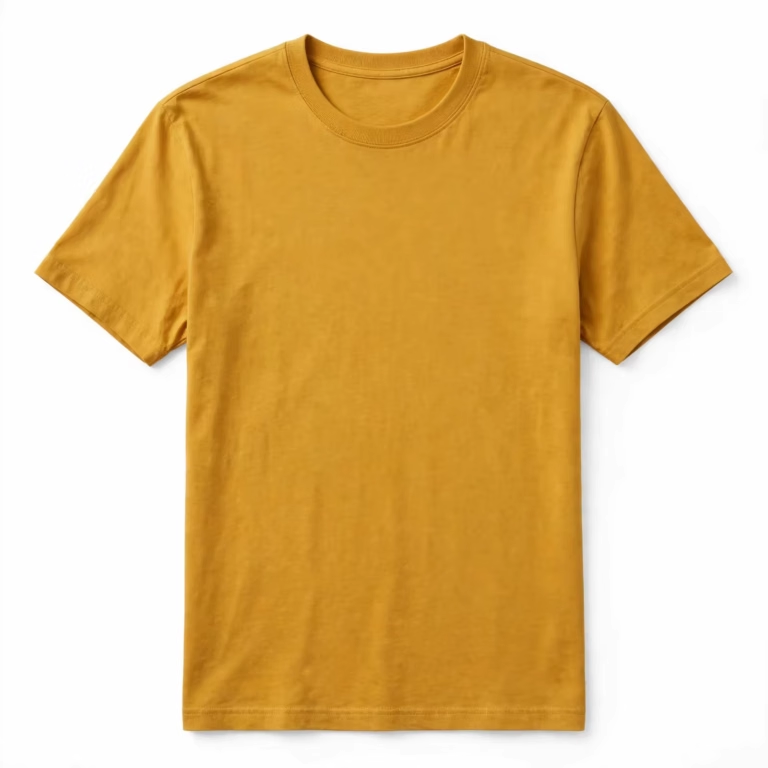
The Mustard Crew Neck Tee, Part by Part
A plain tee has nowhere to hide, which is why it is the hardest garment to make well. This one is judged the way your customers will judge it: neck, shoulders, body and hem, in a colour that shows every fault a maker tries to bury.
The Ribbed Crew Neck
The collar is a ribbed crew band sewn to sit flat and round, with the shoulder seams taped so the neckline keeps its shape through the wash. The neck view in the gallery reads the rib and the shoulder join up close, where a tired tee usually gives itself away first.
- Ribbed band, flat and round
- Shoulder seams taped inside
- No sagging after washing
- Label centred inside the back neck
The Clean Body and Sleeves
The body is cut straight with room to move, and the sleeves are set to sit cleanly without pulling across the chest. In a shade like mustard, any twist in the body shows at once, so the panels are cut on the grain and checked before sewing.
- Straight body, honest room
- Sleeves set flat, no pull lines
- Panels cut on the grain
- Side seams straight and matched
The Plain Back and Hem
The back is one clean mustard panel, and the hem is twin stitched to lie flat whether the tee is worn out or tucked. If your design wants a back print, the panel takes it cleanly; left plain, it gives the shirt its quiet, confident line.
- Single back panel, shade matched
- Twin stitched hem, flat finish
- Back print space kept clear
- Same jersey throughout
T-Shirt Factory in Bangladesh Making for Australian Labels
Siatex makes this tee in Bangladesh for Australian labels, surf and lifestyle brands and retail programmes that want real make quality at an honest landed cost. The mustard shirt in the pictures is one buyer’s lead colour; your production runs in your shades, under your label, on your fit.
Australian seasons run opposite to the northern programmes we also serve, which suits a factory that sews tees all year: your summer range is cut while the north is in knitwear, and your winter layers follow without a queue. The discipline does not change with the hemisphere: an approved sample, a frozen pattern and bulk checked against both.
Custom T-Shirt Supplier in Bangladesh for Sydney and Melbourne Buyers
Sydney and Melbourne labels buy plain tees the way they buy denim: the fit is the brand. A crew neck that keeps its shape and a body that drapes the same in every colour is what turns a first order into a core range, and that is the standard this pattern is held to.
Wholesale T-Shirt Exporter in Bangladesh Shipping to Australian Ports
Wholesale programmes need the boring virtues most: cartons that match their lists, sizes that measure what their labels say and shades that match the last delivery. Those virtues are checked piece by piece here, because a container opened in Brisbane should hold no surprises.
Build Sheet for the Mustard Crew Neck Tee
Your order is sewn against a build sheet agreed before cutting, so the bulk repeats the sample you approved rather than somebody’s memory of it. The sheet for this tee reads as follows, and every line can be reset to your standard.
| Cloth | Single jersey with a smooth face, at the weight your sample approves |
| Colour | Mustard as pictured, or any shade in your colour story |
| Neck | Ribbed crew band with taped shoulder seams |
| Sleeves | Short sleeves, set flat, length from your chart |
| Body | Straight cut with honest room, panels on the grain |
| Back | Plain panel, or your back print on request |
| Neck label | Your woven label on a black ground inside the back neck |
| Size range | Your Australian chart, graded through your full run |
| Carton packing | Folded into your printed polybag, cartons marked by shade and size |
A build sheet earns its keep at the reorder, when the same mustard has to match the shirts already hanging in your stores. The sheet, the dye standard and the approved sample stay on file here so that it does.
Your Label Inside the Back Neck
The gallery’s label view shows the inside of the back neck, where your woven label sits on its black ground against the mustard jersey. It is sewn in while the collar is made, so it stays flat and readable for the life of the shirt.
Your hangtag, your care wording and your polybag print finish the picture. A shopper in Melbourne who picks the tee up meets your name at the neck, on the tag and on the bag, and the factory that sewed it stays out of the story entirely.
- Neck label: your name woven on a black ground, sewn in at the collar
- Care wording: your instructions, set the way your market expects
- Swing tag: your artwork with your price area left ready
- Bag print: your logo and safety wording on every polybag
Checks Before Your Cartons Are Sealed
A plain tee in a strong colour is checked like a printed one, because the faults are the same and the hiding places are fewer. Shade is read under daylight lamps against the standard, necklines are pulled and released, and finished shirts are measured against your chart.
Cartons are counted and weighed against the packing list before sealing. If a shade band or a twisted body appears at checking, it is pulled there, in the factory, rather than discovered by your warehouse team on the other side of the world.
- Shade reading: every batch compared under daylight light
- Neck recovery: collars pulled and checked for spring back
- Measurements: taken from finished shirts, not the pattern alone
- Carton tally: pieces reconciled with the list before the seal
Shade continuity is read across the run, not at one point. Shirts from the first, middle and last cartons of a colour are laid together in daylight; a drift that crept in between dye lots is caught while the cartons are still open here.
Wear the Sample for a Week
Tees are approved too quickly in most buying offices. The sample round here asks for a week: wear the mustard tee, wash it, wear it again, and read the neck, the shade and the body the way your customers will after a month.
Your comments go back to the same table that cut the sample. If the sleeve wants length or the body wants ease, the pattern moves before bulk, and the corrected sample is the one your production is checked against.
Graded for Australian Retail
Australian buyers grade tees relaxed, with lengths that suit an untucked wear and sizes that stay honest into the larger end of the run. Your grading follows your chart exactly, including the extended sizes your stores now treat as standard rather than special.
Because one pattern carries the whole colour story, a customer who trusts the mustard can buy the rust and the sand without a fitting room visit. That trust is the quiet engine of a core tee programme, and it is built entirely on grading that never drifts.
The Reorder Decides Whether the Tee Was Good
A first order proves a factory can make a shirt. A reorder proves it can make the same shirt, and for a core colour like this mustard, the same means the same shade, the same neck, the same body, arriving before your stores run thin.
Your dye standard, build sheet and approved sample stay on file for exactly that test. Labels that build a plain tee into a core range do not change suppliers lightly; our work is to keep deserving that loyalty, one identical delivery at a time.
Mustard Leads, the Story Follows
Mustard leads this page because it is the shade Australian rails are built around this season: warm, honest and easy under a print. Around it, buyers usually run a rust, a washed sand and a deep bottle on the same pattern, building a rail that looks rich without gambling on shades that strand.
Each new colour is approved as a dye standard only; the garment underneath stays the one your customers already trust. Colour is your call at order stage, and the making standard behind it does not move.
From Our Tables to Your Summer Rail
Timing is a quiet part of quality for Australian buyers. Your peak selling weeks land when northern factories are buried in winter orders, so a Bangladesh line that sews tees twelve months a year gives your summer range room to breathe: samples approved early, bulk cut without a queue, and cartons on the water while your competitors are still chasing capacity.
That breathing room shows up in the garment. Rushed tees carry rushed faults: necks sewn under pressure, shades released without a proper reading. A programme planned against the southern calendar gets the same tables, the same checkers and the same care in your busiest month as in your quietest, which is exactly when a core tee range needs them.
Two Weights for Two Australian Summers
A tee sold in Brisbane and a tee sold in Melbourne do different work. The pattern runs in two cloth weights: a lighter knit for northern summer ranges and a firmer mid weight that holds its shape through southern seasons and repeat washing.
Both weights are cut from the same block, dyed to the same standard and sewn on the same lines, so a label can split one colour story across both without the garments looking like cousins rather than twins.
Your sample round includes both weights in your lead colour. Wear them through your own wash cycle and choose per range, per state, or per season, with the fit untouched either way.
The two weights share one dye standard and one set of measurements, so a split order, light tees for the north and mid weight for the south, arrives as one range in two cloths, with no shade step and no fit step between them. Your size run is graded once and used for both.
Questions Australian Buyers Ask About Custom Tees
Can this tee carry our own print or embroidery?
Yes. The mustard base is a clean, smooth jersey that takes chest prints and small embroidery well, or it can be worn plain as pictured. Send your artwork with the sample request and the first sample comes back carrying it, so you judge the finished article rather than a blank.
How do you match the mustard shade on a reorder?
The dye standard approved on your first order stays on file, and every later batch is read against it under daylight lamps before cutting is released. Shade is treated as part of the pattern: it does not drift between deliveries.
What sizes can an Australian programme run?
Your full chart, graded your way, including extended sizes. Finished shirts are measured after sewing, so the size inside the carton is the size on its label, which is the only version of sizing your customers will ever believe.
Building a Core Tee Range That Lasts
Start with the sample in mustard and one supporting colour, wear tested for a week, then let the first range sell. The sizes and shades that clear first will draw the map for your reorder and your next colour story.
When you are ready, send your chart and artwork through the contact page, compare this tee with the men’s mustard crew neck t-shirt it shares its pattern with, the garment dyed t-shirt manufacturer in Bangladesh range, our oversized t-shirt manufacturer in Bangladesh line and the wider t-shirts collection, and find our export profile through the International Trade Centre.