
Custom Mens Indigo Blue White Collar Shirt Manufacturer in Bangladesh for Contrast-Collar Ranges
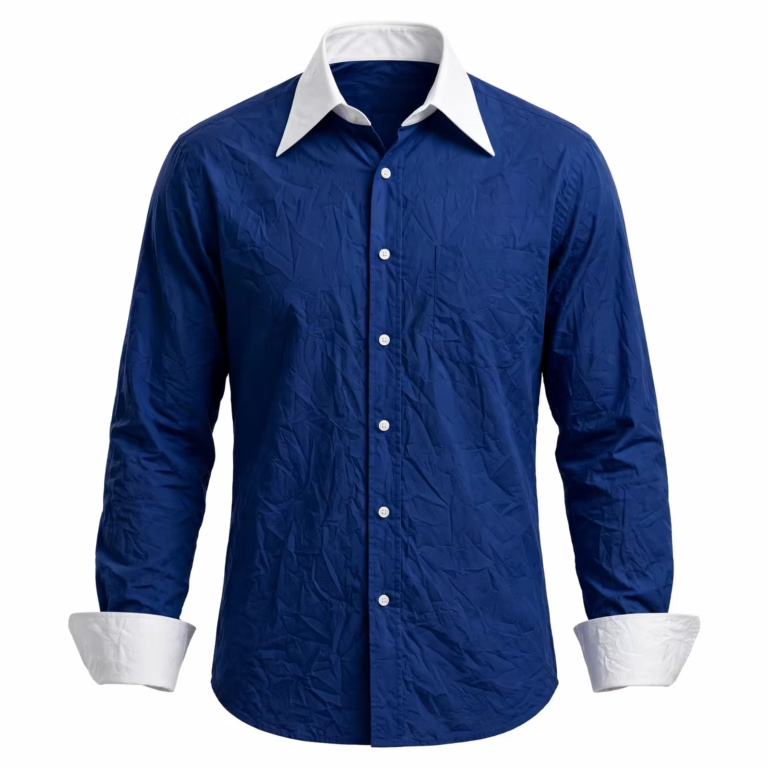
A white collar on a deep blue body is one of the oldest statements in shirting, and this shirt cuts it in a cloth with real character: a crinkled cotton whose texture you can see from across the rail. Siatex makes it in Bangladesh for buyers who want a formal idea with a casual surface.
The shirt is made to your order only. Your blue, your crinkle depth, your collar spread and your measurement chart govern the bulk, sampled first and checked piece by piece before any carton is sealed.
A Solid Indigo Body, Nothing Else
The body, sleeves, placket and pocket are one solid saturated indigo blue, with no stripe, check or print anywhere on it. The colour is chosen deep enough to carry the white contrast and clear enough to stay blue in every light, never drifting toward black.
A solid ground is unforgiving: every seam, button and fold shows. That is why this design works as a quality signal on a rail, because there is nowhere on the shirt for poor making to hide.
The Crinkle, Woven Into the Cotton
The cloth is a woven cotton with a clear, even crinkle across its whole surface, a softly crumpled texture that catches the light in small facets. It is stronger than a seersucker pucker and finer than a crepe, and it turns a plain blue shirt into a textured one without any pattern at all.
The crinkle is set in the cloth before cutting, so it survives washing and needs no iron to look right. Its depth is a sampling decision: the standard here is clear and visible, the same in the body, the sleeves and the white collar and cuffs.
A White Spread Collar With Long Points
The collar is the headline: a wide-spread collar with long, sharp points, cut in solid white, sitting open over the blue chest. The spread is wide enough to frame a tie knot or stand clean without one, and the points reach well down the chest.
The collar band inside is white as well, so the contrast holds from every angle. Collar firmness is your call at sampling: the standard interlining keeps the points flat and the spread open through a full day of wear.
White Turn-Back Cuffs
Each sleeve ends in a wide white cuff turned back outward, flaring slightly wider than the sleeve above it. The turn-back shows the white on the outside of the wrist, echoing the collar and finishing the contrast story at both ends of the shirt.
The cuffs are cut in the same crinkled white cotton as the collar, so the texture matches as well as the colour. Cuff width and flare follow your pattern; the standard here is generous, in proportion with the long collar points.
Six White Buttons Down a Blue Placket
The placket is narrow and cut in the same indigo, and down it run six small white buttons with a soft pearl-like face. White on blue, they continue the contrast in a line down the centre of the shirt, each one evenly spaced from below the collar to near the hem.
The buttons are sewn to survive the wash, and a spare rides in the polybag of every shirt. Button size and face are yours to set at sampling; the white is not negotiable, because it is half the design.
One Pocket in the Same Blue
There is one chest pocket, on the wearer’s left, cut in the same indigo as the body with a straight top opening, no flap and no button. On a solid crinkled ground its outline reads as a quiet tonal seam rather than a feature, which is exactly the register this shirt wants.
The pocket is sized for cards and a phone on the standard block, and its placement is fixed on the pattern so it lands in the same place on every size. Buyers who run a no-pocket formal version can drop it at sampling without touching anything else.
An Almost-Straight Hem With Rounded Corners
The hem runs essentially straight across the body, level from side to side, with softly rounded corners where it meets the side seams. It is a hem made for tucking: straight hems sit flat inside a waistband without the points of a shirttail digging or bunching.
Worn out, the long body covers the waistband fully, and the rounded corners keep the edge from looking chopped. Hem depth and corner radius follow your chart, and the first pieces are checked against it before the run proceeds.
The Back, Yoked Under a White Collar
From behind, a yoke crosses the upper back in the same crinkled indigo, and the white collar stands above it, the only bright element on the back view. The sleeves hang at the sides and end in the white turn-back cuffs, visible from behind as two white bands at the wrists.
The back carries no pleat on the standard block, keeping the slim line clean from shoulder to hem. Your chart can add one if your fit block uses it, and the yoke seam is checked level on the first pieces of every run.
Your Label Inside the White Collar
Inside the back neck, below the white collar band, sits a black woven label carrying the words YOUR LABEL in white capitals. It marks the place where your own brand label is sewn, in your artwork, on every shirt in the order.
Size and care information follow your market’s rules on your instruction. The label position never moves between the sample and the bulk, so what you approve is what your customers find when they look inside.
A Slim Fit With a Long Body
The cut is slim and tailored: close through the chest, a slight taper at the waist, natural shoulders and a long body that falls well below the waistband. It is a dress-shirt block, made to tuck and stay tucked, with enough length that the hem does not ride out when the wearer sits.
Your measurement chart sets every point: chest, waist, length, sleeve, collar and cuff. Our grading follows your chart across the size range, and the fit sample is measured against it before you approve.
How the Two Colours Are Made Together
Production runs on our own lines in Bangladesh. A two-colour shirt is a discipline exercise: white pieces are cut and handled apart from the blue until they meet at the collar and cuff stations, so no blue dust or thread ever lands on the white.
Inline checks follow the collar points, the cuff flare, the button spacing and the colour join at every seam. Final inspection covers measurements, crinkle evenness and finishing, and nothing ships that has not passed the same checks as the signed sample.
Sampling the Contrast and the Crinkle
Sampling starts from your chart and three references: the indigo shade, the white, and the crinkle depth that both colours share. The sample shows them together because the combination is the product; approving the blue alone would miss the point of this shirt.
One careful round usually settles a shirt like this. Once you sign the sample, it becomes the standard for the bulk, and reorders run from the same locked references without fresh development or fresh fitting risk.
Shirts That Sit Beside the Contrast Collar
Buyers building an indigo wall often run the contrast and the check together. The indigo blue check shirt carries a small white graph check in a lightly crinkled cotton, and the royal blue full sleeve shirt runs a clear bright blue with a fine micro-dot texture.
For the formal end of the same rail, the plain grey formal shirt keeps everything quiet. Our wider sourcing follows the standards shared through the International Trade Centre.
What Buyers Ask About the White Collar
Buyers ask whether the white will stay white against the blue in the wash. The two cloths are tested together for colour transfer before bulk, and the care line asks for a cool wash; the contrast is the product, so its survival is tested first, not last.
They also ask whether a collar this white can be stocked without looking fragile in store lighting. The crinkle helps here: its texture keeps the white reading as cloth rather than as a flat bright panel, so the collar holds its own on a rail.
Rails the Contrast Collar Suits
A contrast-collar shirt sells into smart menswear, wedding-party programmes and the dressier end of casual ranges that want one strong shirt in the wall. The white collar reads formal at a distance while the crinkle reads relaxed up close, and that double register is the selling point.
It also works as a uniform shirt for front-of-house teams that need to look sharp without a tie. The long body stays tucked through a shift, and the crinkle means the shirt still looks right at the end of it.
Washing a Crinkled Contrast Shirt
The care story is part of the offer: cool wash, hang dry, no iron. The crinkle is the finish, so the shirt comes off the line ready to wear, and the white collar needs no special treatment beyond the cool wash that protects the contrast.
Care instructions are printed to your market’s rules. The cloth is tested for colourfastness, shrinkage and colour transfer between the two shades before bulk, and the results travel with the sample report.
Folding a Two-Colour Shirt
Each shirt is folded to keep the collar points and the cuff flare, packed singly in a polybag with its spare button, then into export cartons in your size ratio. Carton marks, barcodes and packing lists follow your instruction exactly.
Delivery runs from Bangladesh to your port or consolidator on your terms. Because the two shades and the crinkle are all locked before cutting, packing is the last step of a chain with no surprises left in it at all.
A Collar That Frames the Face
A spread collar this white does a job no blue collar can: it throws light upward and frames the wearer’s face, which is why contrast collars began in formal shirting. The long points keep the frame elegant rather than wide, and the spread leaves room for a tie knot without crowding it.
Without a tie the collar stands open in a clean V over the blue chest, and the first white button sits just below it. Either way the shirt reads dressed, which is the whole reason buyers programme a white collar in the first place.
Start Your White Collar Order
Send your size chart, your indigo reference and your crinkle depth, and we will sample this white collar shirt at your level: your quality, your fabric, your design and your measurement. The sample comes back for your approval before any bulk is cut or sewn.
From that one signed sample, your reorders run on locked references season after season. That is how a contrast programme should work, and it is how we will run yours, with the same indigo, the same white and the same crinkle in every carton.