
Custom Mens Cream Grey and Red Check Shirt Manufacturer in Bangladesh for Large Plaid Shirts in the USA and Europe
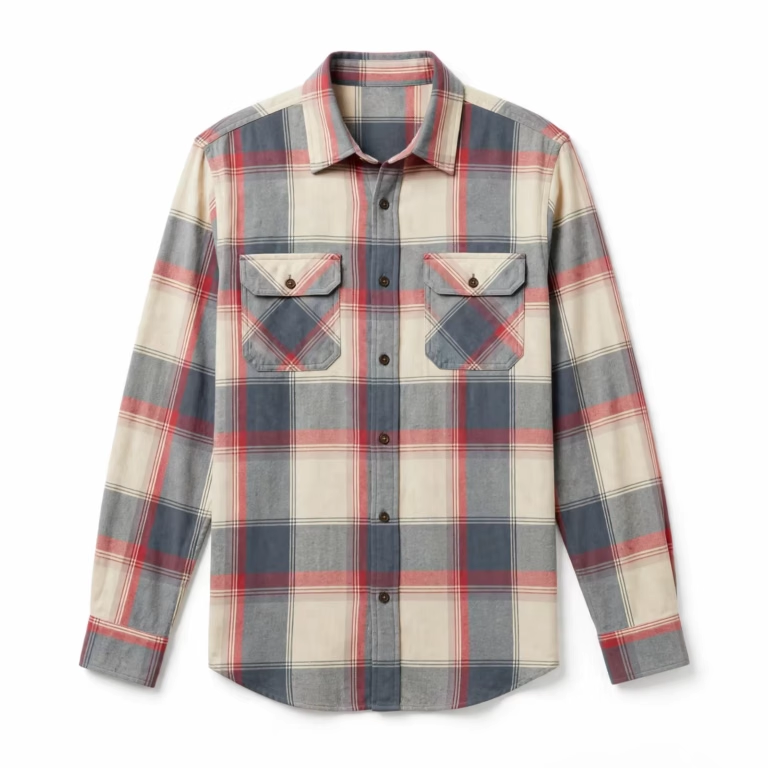
Some checks whisper; this one speaks in broad bands. It is a large plaid shirt in cream, slate grey and muted red, with bias-cut pockets and a softly brushed finish.
Siatex makes it at your level: your plaid held square across the whole order, your brushed cotton, your regular fit and your sizes graded on your own measurement chart. The sections below cover the pattern, the pockets, the cloth and the checks behind the garment.
A Plaid in Broad Bands
The pattern is a large multi-colour plaid with no single ground: broad cream bands and muted slate grey-blue bands cross with slightly narrower soft red bands, both ways. Fine pale pinstripes edge the red, and thin darker grey lines subdivide the bigger blocks.
Where red crosses grey it forms dark slate squares; where it crosses cream, pale pink-red ones. The repeat is large, a block about a fifth of the chest width, and the colours are muted and slightly washed, a heritage palette rather than a bright one.
Brushed Cotton, Softly Textured
The cloth is a soft woven shirting with a lightly brushed, slightly textured face and a matte finish. It drapes with the relaxed softness of a flannel-style plaid without the weight of an overshirt, light to medium and comfortable against the skin.
A brushed plaid lives on its surface: the nap must stay even and the colours soft rather than flat. Both are approved on the strike-off, by eye and by hand, before a single shirt is cut.
A Standard Collar in the Check
The collar is a standard point collar in the same plaid, with moderately wide points and no collar buttons. The inner collar band carries the check too, in a lighter grey-cream passage, with no solid contrast band.
On a large plaid, the collar is where careless cutting shows first: a band landing half a block off reads as a mistake. The collar pieces are placed on the pattern deliberately, so the check sits balanced at the neck.
Six Dark Buttons Down the Front
The front is plain, the check continuing across it with no separate placket panel, and six small dark brown matte buttons run down the centre. Two more close the pocket flaps, eight in all, each one horn-dark against the pale ground.
- Six small dark brown buttons on the front
- One button on each pocket flap
- Plain front with the check running through
- Button shade approved with the strike-off
Dark buttons on a light plaid are a deliberate anchor: they give the eye a rhythm down the front. Their spacing is part of the pattern, set on the approved sample and held in bulk.
Two Pockets, Cut on the Bias
The signature detail is the pockets: two chest flap pockets, each flap with a shallow central point and one dark button. Below the flaps, the pocket bodies are cut on the bias, so their check runs diagonally and forms a diamond with a dark slate square at its centre.
A bias pocket is harder to sew than a matched one, because the cloth wants to stretch as it is handled. It is also the detail that lifts this shirt from a standard plaid to a designed one, and buyers notice it in the hand.
Full Sleeves With Buttoned Cuffs
The sleeves are full length with single-button cuffs, hanging straight from a natural shoulder. The style also folds up neatly toward the elbow, which is how many wearers style a brushed plaid in milder weather.
Sleeve length is graded with the sizes on your chart, so the cuff lands at the wrist in every size. The plaid runs down the sleeve in the same broad bands as the body, placed to sit comfortably at the armhole.
A Relaxed Fit With a Curved Tail
The fit is regular to relaxed, straight through the body with no darts, and the hem is a gently curved shirttail, dipping at the centre and rising softly at the sides. The body is long, finishing at hip length, so the shirt tucks or wears out with a finished line.
Sizes run from XS to XXL, graded on your measurement chart. On a large plaid, grading is also pattern work: the repeat is placed so the big blocks sit in the same positions across the size range.
The Back, Yoke and Plaid
The back carries a yoke across the shoulders, with the plaid continuing below it in the same broad bands. From behind, the shirt reads as pure pattern, the cream and slate blocks alternating with the red crossings.
There is no back print and no external branding. The check is the whole design, front and back, which is what makes the shirt so easy to merchandise as a statement piece.
Your Label on the Collar Band
Your label is woven to your artwork and sewn inside the back neck, centred on the collar band. On a shirt with no print, that label is the identity, seen every time the garment comes off a hanger.
Care and size information follows your market’s format. Your hangtags, stickers and polybag print complete the presentation, so the shirt reaches your rail as your product in every detail.
Where a Large Plaid Sells
A heritage plaid like this one anchors autumn and winter casual ranges, workwear-inspired edits and flannel-shirt programmes, and it layers over tees as a light overshirt in the shoulder seasons. The cream-led palette keeps it brighter than the usual dark plaid, which widens its selling window.
- Autumn and winter casual shirt ranges
- Workwear and heritage-inspired edits
- Flannel and brushed shirt programmes
- Private label capsules built on plaid
Because the pattern is woven rather than printed, it does not date with a print trend. A buyer can stock this shirt season after season as a range staple.
Companion Shirts on the Same Bench
The shirt bench covers plaid at several scales. For a bolder windowpane, the royal blue with lemon check shirt runs a large grid in stronger colours.
For a finer pattern, the light brown and white check shirt shows the small tattersall end of the range, and the light blue stripe half sleeve shirt covers the summer weight. Trade guidance for apparel exporters is published by the International Trade Centre.
Holding a Large Plaid True in Bulk
A large repeat is unforgiving: a band landing a centimetre off at the front edge shows at once, and the two fronts must mirror each other. The plaid is matched at the centre front and read across both fronts before packing, garment by garment.
The bias pockets add their own discipline, cut and sewn so the diamonds sit level as a pair. That is slow work, and it is exactly the work that separates a designed plaid from a cheap one.
Sampling a Brushed Plaid
The strike-off settles the palette first: the cream must stay warm, the slate grey-blue and the red muted, because a plaid never reads true on a screen. The brushed hand feel is approved at the same time, soft without fluffing.
The fit sample then confirms the collar placement, the pocket diamonds and the curved tail worn and tucked. Once pattern, fit and finish are signed, bulk repeats them.
Packing a Brushed Shirt
Each shirt is folded with the front buttons protected and the collar sitting in shape, sealed in its polybag with your stickers. A brushed surface marks if it is crushed, so the fold is packed to arrive smooth rather than pressed flat by the carton.
Cartons are marked with your references, sizes and the colourway name. The packing list mirrors the carton marks line for line, so a warehouse can split a delivery without opening every bag.
Questions Buyers Ask About the Big Plaid
Are the pockets really cut on the bias? Yes, the pocket bodies are cut diagonally on purpose, forming the diamond at the centre of each pocket; the flaps above them run straighter, which is the design’s contrast.
Is it a flannel? It is a brushed cotton shirting in a flannel style, light to medium in weight: softer and warmer in feel than a plain poplin, without an overshirt’s bulk.
Can the palette move? Yes, the plaid structure is the pattern: the band widths and crossings stay, and the three colours are set to your standard, so the same shirt can run in your own palette.
Reorders on a Heritage Plaid
Heritage plaids reorder well because they are staples rather than novelties: the repeat, the pocket cutting and the fit are held with the order, so this season’s shirt hangs beside last season’s without a visible step. The pattern placement and the measurement chart are filed together for exactly that reason.
That consistency is what turns a single trial into a standing line. The garment is familiar; keeping it identical is the work, and it is done at the loom and checking stages, not left to chance.
The Diamond at the Pocket
Look at the pockets and the cutting logic shows: the flap runs with the body’s check while the pocket below it turns forty-five degrees, so the bands cross into a diamond and a dark slate square lands at the centre of each pocket. Placed as a pair, the diamonds balance the front.
That symmetry is checked, not assumed: the two pockets are read together on the finished garment. A diamond sitting higher on one side is a reject, however good the rest of the shirt is.
Washing a Brushed Plaid
A brushed surface is tested for more than colour: the nap must come out of the wash even, not roughened in patches, and the three colours must hold against each other where the bands cross. The cream bands show any bleed first, so they are read first.
The care label carries your instructions in your market’s format. A plaid that washes as softly as it sold is the one that earns its reorder.
Plaid Placement Across Sizes
Grading a large plaid is pattern placement as much as measurement: the big cream block that sits at the chest of a medium should sit at the chest of an extra-large too, not drift toward the shoulder. The marker is planned size by size to hold those positions.
That planning is why the range photographs as one family. A buyer laying the sizes side by side sees the same shirt, larger, not a different arrangement of the same cloth.
Start Your Plaid Shirt Order
Send your plaid standard, your size chart and your label artwork, and the strike-off and sample follow. Your bands, your brushed cotton, your fit and your label, made in Bangladesh at your level, with the diamonds sitting level and the fronts mirroring from the first shirt of the order to the very last single one.