
Custom Mens Royal Blue with Lemon Check Shirt Manufacturer in Bangladesh for Bold Windowpane Flannel in the USA and Europe
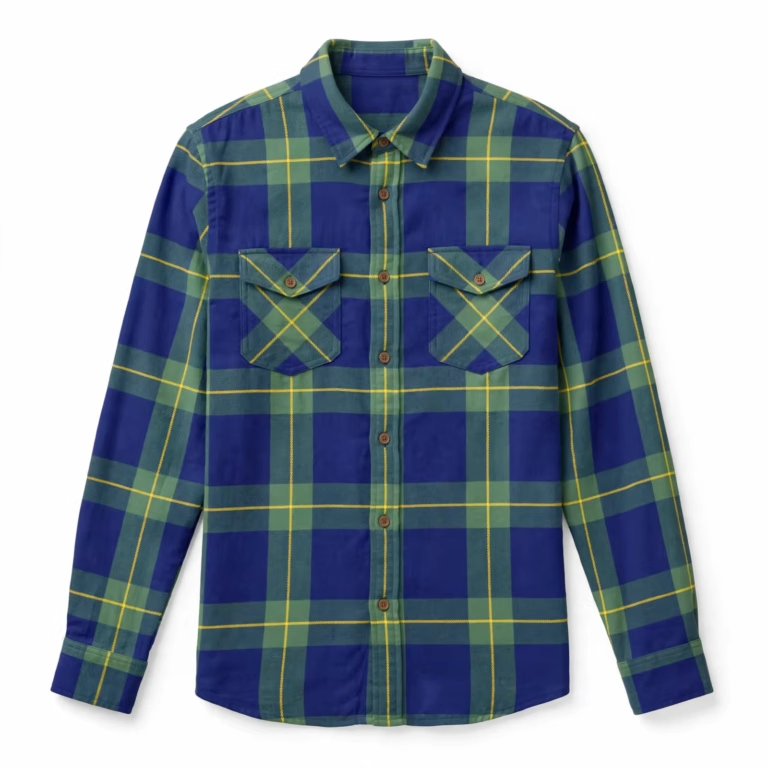
Some checks whisper; this one talks. A large windowpane of broad forest-green bands and single lemon lines over a deep royal blue ground gives this flannel shirt a strong shelf presence, while the two buttoned flap pockets keep it grounded in workwear.
Siatex makes it at your level: your blue, green and lemon matched to your standards, your brushed flannel, your regular fit and your sizes graded on your own measurement chart. The page that follows covers the pattern, the pockets, the flannel and the matching discipline a big check demands.
Reading the Windowpane
The pattern is built in layers. The ground is a clear, deep royal blue, woven in large blocks roughly a third of the torso wide, so the shirt reads blue first at any distance.
Across those blocks run broad muted forest-green bands, three to four times wider than the yellow lines, forming the main grid. Where the green bands cross, the colour deepens into a blue-green, which gives the pattern its tartan depth.
The Single Lemon Line
The third layer is the one the shirt is named for: a single thin lemon-yellow line, one per repeat in each direction, crossing the green bands and staying visible over them. There are no pairs and no doubles; the restraint is what makes the line read as a highlight.
On the placket the lemon line runs down the centre, and on the pocket flaps it turns diagonal, converging toward the button. A buyer who understands checks will read those two details as the signature of the design.
Two Flap Pockets With Pointed Bottoms
The chest carries two flap pockets, one on each side, each flap ending in a point at the centre and closing with one small brown button. The flaps are cut so their lemon lines form a V toward the button rather than following the straight grid.
- Two chest pockets with pointed-bottom flaps
- One matte brown button on each flap
- Flap lines converging in a V on the button
- Pocket bodies continuing the main grid
Cutting a flap on the diagonal costs a little more cloth and a little more care at the matching table. It is also the detail that lifts the shirt out of the plain flannel crowd, which is why it stays.
Brown Buttons Down a Checked Placket
The placket is narrow, in the same check, with the lemon line down its centre. Six small matte mid-brown buttons run from below the collar to near the hem, their warm tone sitting comfortably against both the blue and the green.
Button spacing on a large check is a matching decision as much as a sewing one: the buttons are set so the horizontal bands pass at the same point on every size. That consistency is checked on the sample and held through the grading.
A Standard Collar Over a Striped Band
The collar is a standard point collar in the same check, its points carrying the diagonal lemon line like the pocket flaps. Inside the back neck, the collar band is dark with a thin teal-green stripe, a quiet detail that shows when the shirt hangs open.
The collar is cut from the same cloth lot as the body and matched at the points. On a bold check, a mismatched collar point is the first fault a buyer sees, so it is the first thing the sample review checks.
Brushed Flannel With a Matte Face
The cloth is a lightly brushed flannel-style cotton: matte, soft, with no shine and a gentle surface texture. Brushing softens the colour edges slightly, which suits a tartan-style check better than a crisp poplin would.
The weight is set with you at sampling. A mid-weight flannel carries this shirt through autumn and winter ranges; a lighter brushing can take the same pattern toward transitional edits, with the construction unchanged.
Full Sleeves, Whatever the Photograph Shows
The source styling rolls the sleeves to the elbow, but the shirt itself is a full-sleeve garment. The sleeves run to the wrist and close with single-button cuffs, cut in the check with the bands matched at the cuff line.
That matters for buyers writing honest listings: the delivered garment is a long-sleeve flannel shirt, and the rolled look is styling, not construction. Your product copy can say so plainly, because the garment behind it agrees.
A Regular Fit With a Straight Hem
The fit is regular and straight, with natural shoulders and a hip-length body. The hem runs essentially straight across, rounding only slightly at the corners, so the shirt wears tucked or untucked without a deep tail swinging.
Sizes run from XS to XXL, and the check is graded as a pattern, not just scaled as a garment. The blocks stay proportional at the ends of the range, so a large size still shows the same three-column front the sample approved.
Your Label Under the Collar Band
Inside the back neck, below the dark collar band with its green stripe, your label is woven to your artwork and sewn in. It is the first thing a buyer sees when the shirt comes off the rail, and it carries your name, not ours.
Care and size information follows your market’s format. Your hangtags and polybag print complete the presentation, so the shirt arrives ready for your shelf exactly as your range presents itself.
Who Buys a Bold Check Flannel
Large checks earn their place in autumn and winter edits, in outdoor and workwear-inspired ranges, and in any rail that needs one strong pattern among plains. The lemon line gives this one a talking point most tartans do not have.
- Autumn and winter casual ranges
- Outdoor and workwear-inspired edits
- Pattern anchors in otherwise plain rails
- Flannel programmes for cold-climate markets
Because the construction is a classic shirt underneath the pattern, the same block also runs in quieter checks for buyers building a good-better-best flannel wall.
More Check Shirts From the Same Line
The check line spans bold and quiet patterns. For a finer grid, the blue, white and yellow check shirt runs a windowpane on a blue ground, and the pastel green and cream check shirt takes the pattern soft.
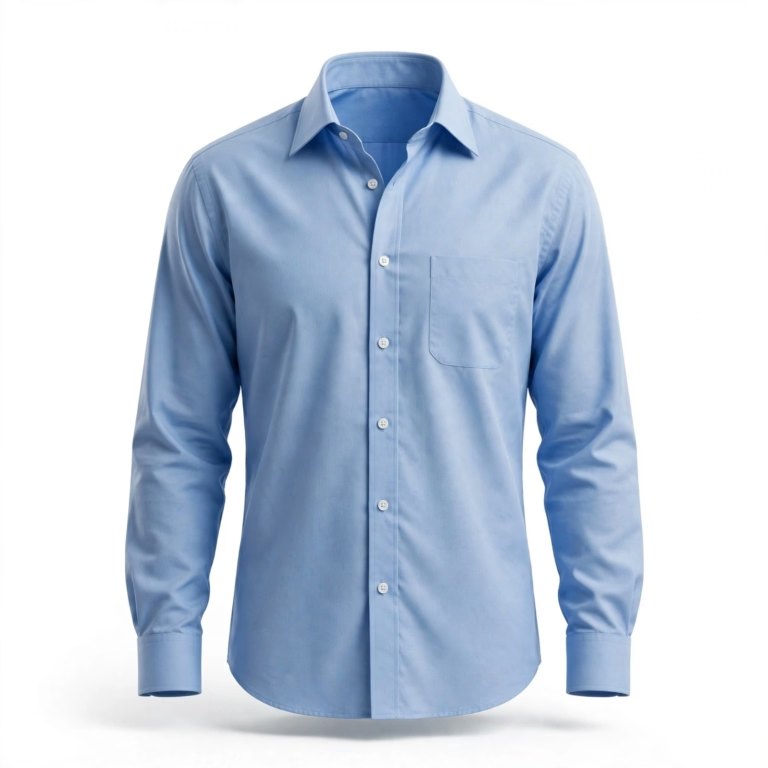
For a plain option beside the checks, the light blue full sleeve shirt carries the same regular block. Pattern and range advice for exporters is published by the International Trade Centre.
Matching a Large Check at the Cutting Table
A windowpane this size is matched panel by panel: the front bands must meet at the placket, the pocket bodies must continue the grid, and the yoke must sit level with the front shoulders. The cutting plan is drawn from the approved sample before bulk cloth is spread.
That planning costs a little cloth against a plain shirt, and it is never recovered by skipping matches in hidden places. A check shirt is judged at its seams, so the seams are where the effort goes.
Sampling the Green and the Lemon
Two colours in this pattern need sampling care: the forest green, which must stay muted rather than bright, and the lemon, which must stay a single fine line at the woven width. Both are approved on the woven strike-off, not on a printed picture of it.
The full sample then confirms the flap V, the placket line and the button tone together. Once those are signed off, bulk is a repetition exercise with the sample on the table at every stage.
Packing a Flannel Shirt
Each shirt is buttoned, folded with the collar protected, sealed in its polybag with your stickers and packed flat. Flannel brushes can mark against rough carton edges, so cartons are lined and the shirts travel face-protected.
Mixed-check cartons are separated and labelled by pattern name, so a warehouse can split a flannel delivery without opening every bag. The packing list mirrors the carton marks line for line.
Questions Buyers Ask About This Shirt
Is the blue as dark as navy? No: the ground is woven as a clear deep royal blue, brighter than the studio photograph of the original suggests, and the lab standard is the approved woven strike-off.
Are the sleeves really full length? Yes, the garment is a full-sleeve shirt with buttoned cuffs; the rolled sleeves in the source styling are presentation only.
Can the check be recoloured? The same construction carries other colourways, with the green and lemon roles reassigned to your palette and re-approved at strike-off.
Reorders Keep the Same Repeat
A check lives or dies on its repeat size, so the woven repeat, the band widths and the line positions are filed with the order. A reorder woven to a slightly smaller repeat would look like a different shirt on the same rail.
The filing covers the button tone, the flap cut and the matching points as well. When the second order arrives, it is checked against the first delivery’s retained sample before it is released.
The Yoke and the Back
The back carries a yoke across the shoulders, with the check running level into the front at the shoulder seams. Below the yoke the pattern falls straight, the green bands keeping their spacing down to the hem.
A yoke on a check shirt is a matching test in itself: if the yoke bands sit even a few millimetres off the front’s rhythm, the shoulder line looks broken. The cutting plan sets the yoke from the same repeat position on every size.
Holding the Lemon Through Washing
A fine yellow line is the first part of a check to suffer if the dyeing is weak, so the lemon yarn is wash-tested with the full pattern before bulk weaving. The line must come out of the wash the same lemon it went in, against both the blue and the green.
That test is what lets a buyer stock a bold check with confidence across a season. A shirt whose highlight line fades by the third wash stops looking like the sample, and reorders die with it.
Sleeve Plackets and Cuff Buttons
Each cuff closes with a single brown button matching the front, and the sleeve placket above it carries the check in line with the sleeve. The cuff is cut so a green band or a blue block lands at the same point on both sleeves, keeping the pair symmetrical.
That symmetry is checked with the shirt laid flat, sleeves side by side, before the pair is passed. Two sleeves that tell different stories are a fault on a check garment, however good each one looks alone.
Start Your Lemon Check Shirt Order
Send your colour standards, your size chart and your label artwork, and the woven strike-off and sample follow. Your check, your flannel, your fit and your label, made in Bangladesh at your level, with every band matched and every lemon line holding its colour through the season.