
Custom Mens Soft Blue Designer T-Shirt Manufacturer in Bangladesh for Melange Chest-Panel Tees in the USA and Europe
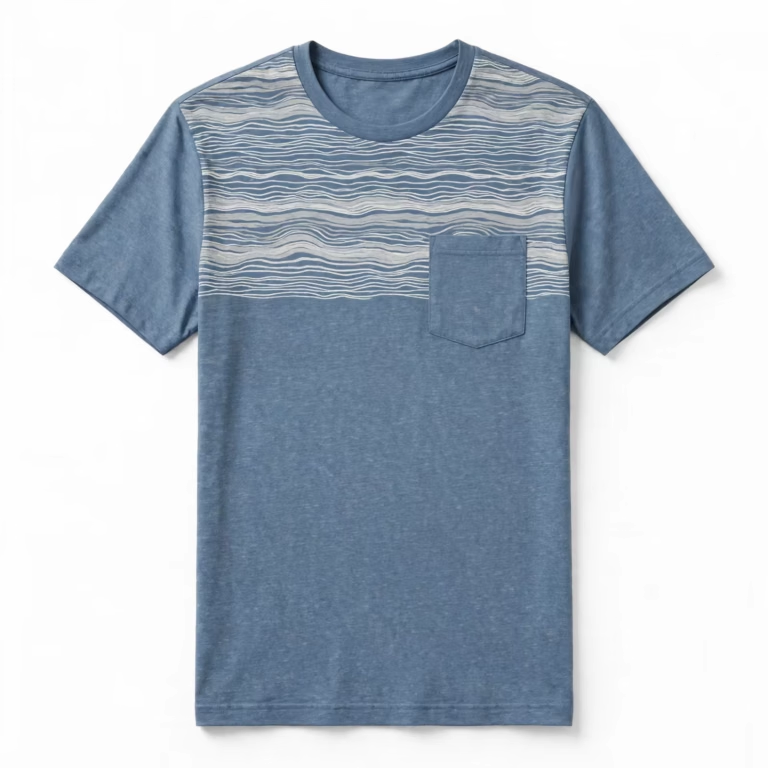
Some tees are plain; this one carries its design in a band of moving water. It is a soft blue melange tee with a wavy-line chest panel and a single pocket, quiet and designed at once.
Siatex makes it at your level: your soft blue held true across the whole order, your melange jersey, your regular fit and your sizes graded on your own measurement chart. The sections below cover the panel, the pocket, the cloth and the checks behind the garment.
A Soft Blue, Melange All Through
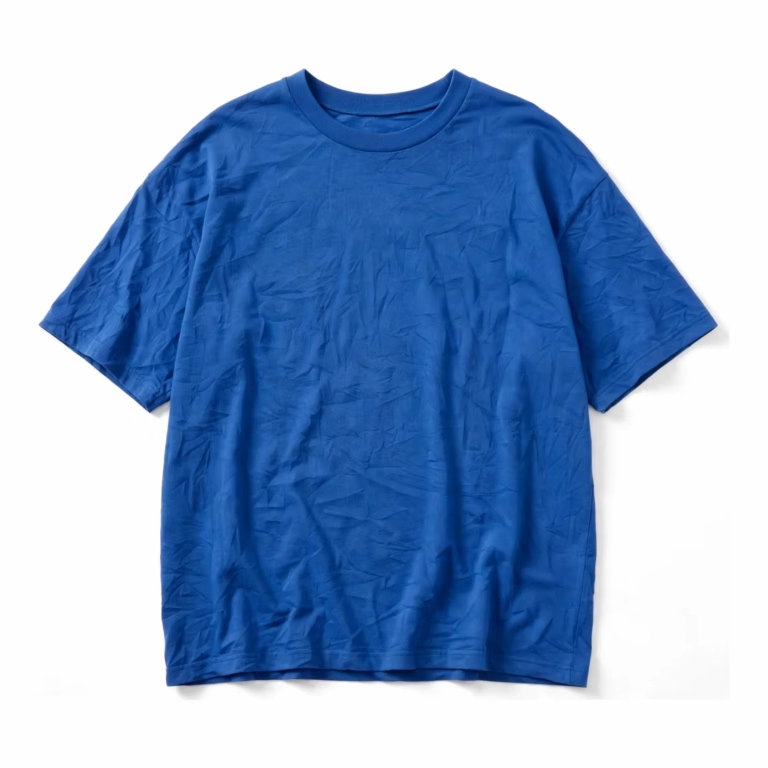
The colour is a light-to-medium soft blue, cool and dusty, heathered through the whole garment with fine pale flecking. It is not a flat solid: the melange yarn blends lighter and darker fibres inside every thread, so the surface has depth even where nothing is printed.
That depth is the base of the design. A melange ground makes a printed panel look woven into the garment rather than pasted onto it, and it forgives the small variations of everyday wear better than a flat dye.
A Panel of Rippled Water
Across the upper chest runs a wide printed panel, side to side, filled with dense irregular wavy lines in off-white and very pale grey. The lines rise and fall like rippled water, roughly symmetrical about the centre, calm at a distance and detailed up close.
- Wide horizontal panel across the upper chest
- Dense wavy lines in off-white and pale grey
- Print drawn for this garment, placed to the sample
- Panel edges level across the whole order
A chest panel lives on its placement: a few millimetres high or low and the garment’s balance changes. The panel is positioned from the approved sample and read on every garment before packing.
Melange Jersey, Fine and Matte
The cloth is a fine single jersey, smooth and lightweight, with the speckled texture of a true melange and a matte finish. It drapes softly without clinging, which suits the slim-to-regular cut and the long body.
Melange quality is read in the yarn, not the surface: light and dark fibres blended inside each yarn, with soft streaky variation along the rows. A flat, uniform screen reads as plastic, and that is the failure this cloth is checked against first.
A Shallow Crew With a Bound Edge
The neckline is a round crew, close-fitting and shallow, finished with a narrow self-fabric binding carrying a slightly darker thin edge. There is no collar, no placket and no button: the neck is a clean frame for the panel below it.
A shallow crew has to sit flat and keep its circle after washing. The binding is set with its recovery checked on the sample, so the neck frames the print the same way in month six as on day one.
One Pocket Over the Panel
On the wearer’s left chest sits a single patch pocket in the same heathered blue, with a straight open top and no flap or trim. It overlaps the end of the printed panel, and its lower edge finishes level with the panel’s lower edge.
That overlap is the design’s quiet joke: the pocket interrupts the water, solid blue over moving lines. It is placed to the millimetre from the sample, because the joke only works when the edges meet exactly where they should.
Short Sleeves With Plain Hems
The sleeves are short and set in at the natural shoulder, ending at mid-upper arm with plain narrow hems in a slightly darker blue. There are no cuffs, bands or folds: the sleeve is as quiet as the lower body, so the chest does the talking.
Sleeve length is graded with the sizes on your chart. On a panel tee, the sleeve also frames the panel’s ends, so its set is checked against the panel line on the finished garment.
Slim-Regular, Long in the Body
The fit is slim to regular, straight through the torso with a slight narrowing at the waist, and the body is long, finishing well below the waist at hip length. The hem is straight and narrow, with no side vents, so the line stays clean tucked or untucked.
Sizes run from XS to XXL, graded on your measurement chart. The panel position is graded as a proportion of the chest, so the water sits at the same height in every size.
The Back, Plain Melange
The back is plain melange blue from neck to hem, with no print and no branding. From behind, the garment is colour and texture alone, which balances a front that carries the design.
That restraint is what makes the tee easy to range: it styles as a designed piece from the front and a soft basic from the back, and it layers under open shirts without a second print fighting through.
Your Label Inside the Crew
Your label is woven to your artwork and sewn inside the back neck, centred at the crew. On a tee whose only graphic is an abstract panel, that label is the identity, and it is placed where a wearer sees it every time the garment goes on.
Care and size information follows your market’s format. Your hangtags, stickers and polybag print complete the presentation, so the tee reaches your rail as your product in every detail.
Where a Panel Tee Sells
A melange panel tee sits in designed basics ranges, surf-leaning capsules and summer edits, anywhere a plain tee is too plain and a loud graphic is too loud. The water panel reads coastal without a single literal image, which widens where it can be sold.
- Designed basics and premium tee ranges
- Surf and coastal-leaning capsules
- Summer edits built on soft blues
- Private label programmes needing a quiet graphic
Because the graphic is abstract, it does not date with a slogan or a season’s motif. A buyer can stock this tee as a designed staple and bring it back while the colour story holds.
Companion Tees on the Same Bench
The tee bench covers melange and panel work in several colours. For a warmer melange, the soft maroon textured full sleeve t-shirt runs the same flecked yarn logic in a long sleeve.
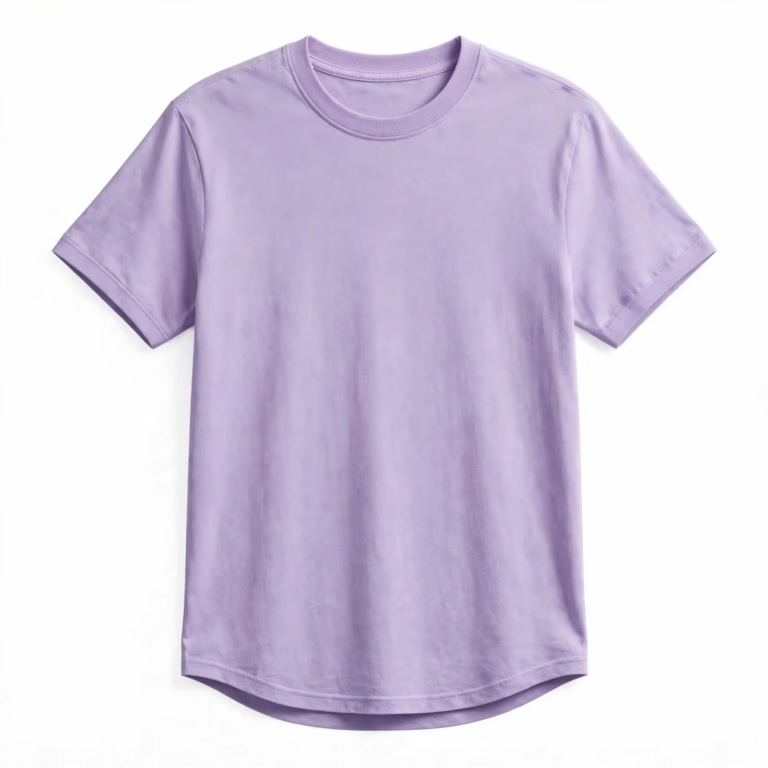
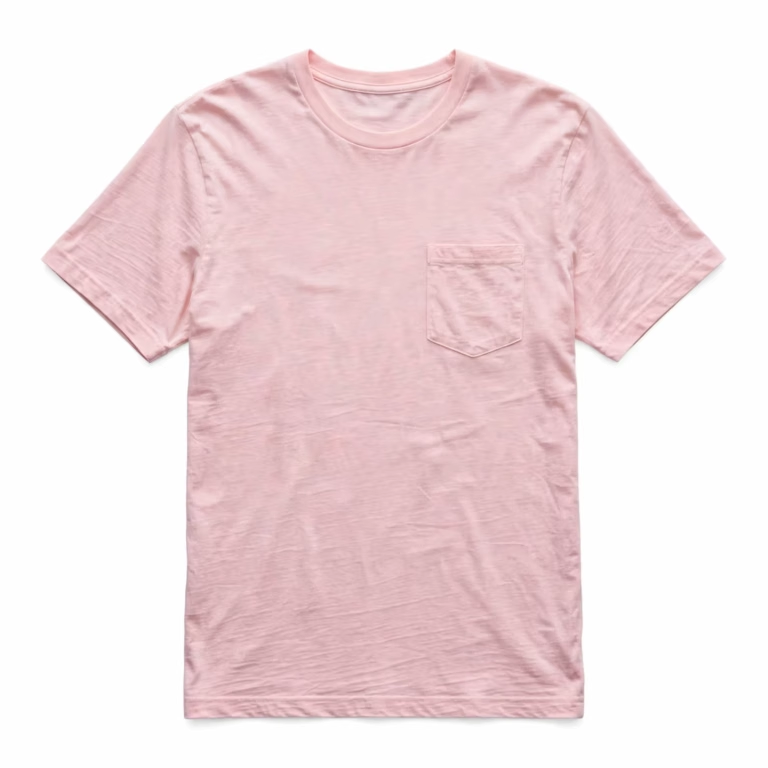
For a brighter plain, the pink t-shirt shows the bench’s scoop-neck work, and the beige full sleeve t-shirt covers the henley neckline. Trade guidance for apparel exporters is published by the International Trade Centre.
Holding a Melange True in Bulk
Melange drifts quietly: a yarn lot a shade deeper reads as a different garment once it is sewn beside the approved one. Body, sleeves and pocket are read together as one garment before packing, so no single tee carries two blues.
The pocket makes that read sharper, because it sits over the panel as a solid patch of the same cloth. If the pocket’s melange differs from the body’s, the eye finds it at once, and that garment does not ship.
Printing the Water So It Lasts
A fine-line print fails in two ways: lines that fill in, and lines that crack. The wavy panel is printed with its line weights set for the jersey’s surface, then wash-tested on the sample so the water stays crisp rather than blurring into stripes.
The print hand feel matters as much as the look: the panel should flex with the cloth, not sit on it as a plate. That softness is approved by hand before bulk, and it is part of what the buyer is paying for.
Sampling a Panel Tee
Sampling starts with the melange and the panel together: the blue approved under daylight, the wavy lines drawn and positioned, the pocket’s overlap set. A panel tee is sampled on those relationships, because they are the design.
The fit sample then confirms the shallow crew’s sit, the panel height worn, and the long body’s line, washed and worn. Once those are signed, bulk repeats them without drifting into a plainer tee.
Packing a Melange Tee
Each tee is folded with the panel flat and uncreased, sealed in its polybag with your stickers. A printed panel folded on its lines can mark, so the fold is placed to keep the water smooth in transit.
Cartons are marked with your references, sizes and the colourway name. The packing list mirrors the carton marks line for line, so a warehouse can split a delivery without opening every bag.
Questions Buyers Ask About the Panel Tee
Is the panel printed or woven? It is printed, with fine wavy lines in off-white and pale grey over the melange ground; the ground itself is yarn-dyed melange, so the texture under the print is real cloth, not an effect.
Why does the pocket cover the print? By design: the solid pocket over the moving lines is the garment’s detail, and its lower edge is set level with the panel’s edge on every garment.
Can the panel change? Yes, the placement is the pattern: your own artwork runs in the same chest band on the same melange block, in your colours, so the tee can anchor a capsule in your palette.
Reorders on a Designed Basic
Designed basics reorder on recognition: the buyer wants the same blue, the same water, the same pocket placement, because their customers already know the garment. The yarn standard, the artwork and the measurement chart are filed together so a reorder is a repeat, not a reinterpretation.
That consistency is what turns a single trial into a standing line. The garment is familiar; keeping it identical is the work, and it is done at the yarn, print and checking stages, not left to chance.
The Pocket Edge, Set Level
The pocket’s lower edge and the panel’s lower edge are meant to read as one line, and that line is set from the sample with a tolerance a buyer can measure. On the finished garment the two edges are read together, left against the line, before the tee is folded.
It is a small discipline with an outsized effect: the front looks composed rather than assembled. Composed is the difference between a designed tee and a printed one.
Washing a Melange Print
The wash test reads two things at once: the melange must not fade unevenly, and the wavy lines must stay off-white against it rather than greying into the ground. Fine lines show any change first, so they are read first, under daylight.
The care label carries your instructions in your market’s format. A panel that washes as calmly as it sold is the one that earns its reorder.
Start Your Soft Blue Order
Send your colour standard, your artwork and your label file, and the strike-off and sample follow. Your blue, your melange, your panel and your label, made in Bangladesh at your level, with the water sitting level and the pocket meeting its edge from the first tee of the order to the very last one packed in the carton.