
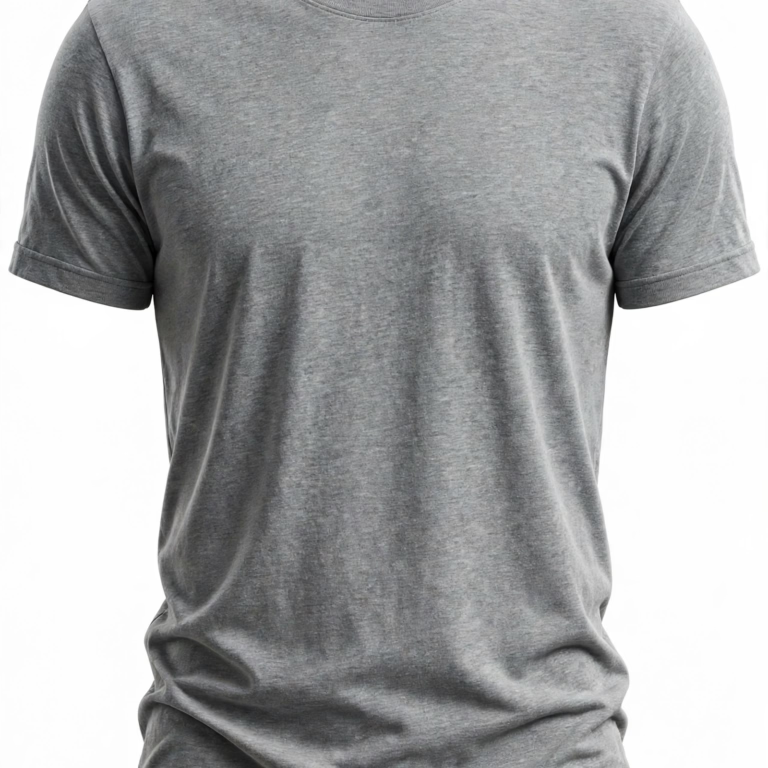
Custom Mens Soft Maroon Textured Full Sleeve T-Shirt Manufacturer in Bangladesh for Melange Henley Tees in the USA and Europe
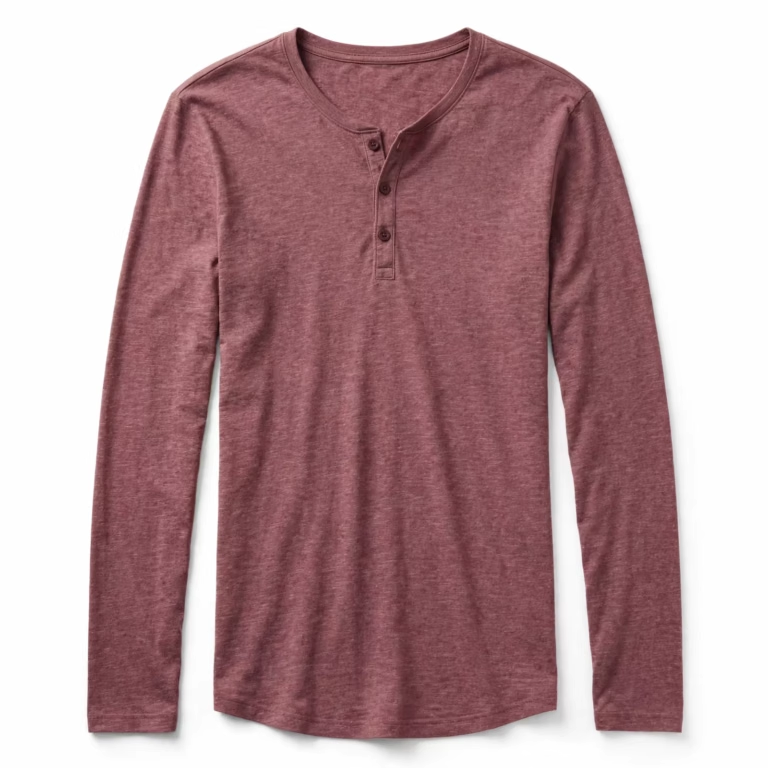
Some tees are flat colour and flat interest; this one carries its character in the yarn. It is a full sleeve tee in a dusty maroon melange, with a henley neck, three dark buttons and a gently curved hem.
Siatex makes it at your level: your melange held even across the whole order, your soft textured jersey, your regular fit and your sizes graded on your own measurement chart. The sections below cover the colour, the texture, the neck and the checks behind the garment.
Dusty Maroon, Softer Than Solid
The colour is a soft muted dusty maroon, a faded burgundy with a wine-rose cast, lighter and pinker than a deep solid maroon. It is the same on the body, sleeves and neck band, with no contrast anywhere.
A dusty shade like this sits in the premium end of a basics rail: rich without shouting, easy with denim and chinos, and forgiving under store lighting. It is a colour buyers choose when black and grey have done their turn.
A Melange You Can See
The texture is a fine heathered melange: lighter pinkish and darker maroon fibres blended inside the yarn itself, giving the surface an even granular grain and a slightly washed, speckled look. Nothing is printed on; the character is in the cloth.
Melange is also a quality signal a customer can feel. The jersey is lightweight to medium, soft and smooth with a relaxed drape and a matte finish, the kind of hand feel that lifts a plain tee out of the commodity pile.
A Henley Neck With Three Buttons
The neckline is a henley: a wide, shallow, rounded opening that dips to a soft V point where the placket begins. A narrow self-fabric band finishes the edge, in the same maroon, with no contrast trim.
- Wide shallow henley opening with a soft V point
- Short placket with three small dark buttons
- Narrow self-fabric neck band in the same maroon
- Top button worn open or closed, both tidy
The three buttons are small, round and tonal dark maroon-brown. On a garment with no print and no pocket, that placket is the whole design, so its stitching and button alignment are checked garment by garment.
Full Sleeves, Plain Hems
The sleeves are full length with plain narrow hems in the same melange. They hang straight and follow the arm without excess volume, finishing a long clean line from shoulder to wrist.
The style also folds up neatly to below the elbow, which is how many wearers style it in warm weather. Sleeve length is graded with the sizes on your chart, so the full sleeve lands at the wrist in every size.
Nothing Else on the Front
There is no pocket, no print, no logo and no embroidery. Apart from the henley placket, the front is one field of dusty melange, and that restraint is the design: the texture does the talking.
For a buyer, a plain melange is the easiest kind of premium to sell, because it photographs rich, layers under everything and never dates. Your branding enters at the neck label, where it belongs.
A Regular Fit, Long in the Body
The fit is regular and straight, falling cleanly from chest to hem without tapering, with the shoulders on the natural line. The body is long, covering the hips, so the tee tucks properly or wears out with a finished look.
The hem is gently curved, dipping a little lower at the centre and rising softly toward the sides, with a plain narrow stitched edge and no side vents. Sizes run from XS to XXL, graded on your measurement chart.
A Plain Melange Back
The back is one plain field of the same dusty melange, with the narrow neck band seen from behind. There is no back detail and no external branding anywhere on the garment.
From behind, the tee reads as pure colour and texture, which is what makes it so easy to merchandise across a range. The buyer’s label inside the neck is the only name it carries.
The Label at the Neck Band
Your label is woven to your artwork and sewn inside the back neck, centred below the neck band. On a tee with no print, that label is the identity, seen every time the garment is taken off a hanger.
Care and size information follows your market’s format. Your hangtags, stickers and polybag print complete the presentation, so the tee reaches your rail as your product in every detail.
Where a Melange Henley Sells
The melange henley sits at the crossing of basics and fashion: premium basics programmes take it for the texture, casual ranges for the neckline, and layering edits for the long body and full sleeves.
- Premium and textured basics ranges
- Autumn layering and transitional edits
- Private label capsules in dusty shades
- Loungewear-adjacent casual programmes
Dusty shades sell across seasons because they are neither summer-bright nor winter-dark. A buyer can stock this tee from early autumn through spring without it stranding.
Companion Tees on the Same Block
The tee bench covers plain, textured and colour-led styles. For another henley neck, the beige full sleeve t-shirt runs the same neckline in a warm solid jersey.
For a brighter colour story, the pink t-shirt shows the scoop-neck end of the range, and the olive green tank top covers the sleeveless base. Trade guidance for apparel exporters is published by the International Trade Centre.
Holding a Melange Even in Bulk
A melange is a ratio before it is a colour: too much light fibre and the tee washes out, too much dark and it turns heavy. The blend is fixed at the yarn stage with the order, and body, sleeves and neck band are read together before packing.
That is why melange programmes fail when they are bought carelessly and succeed when the yarn source is held. The approved yarn is filed with the order like a dye recipe.
Sampling a Textured Tee
The strike-off settles the blend by eye and by hand: the fleck balance and the grain are approved on cloth, because a melange never reads true on a screen. The hand feel is part of the approval, soft against the skin with no scratch from the textured yarn.
The fit sample then confirms the henley depth, the button spacing and the curved hem worn and tucked. Once blend, fit and finish are signed, bulk repeats them.
Packing a Melange Jersey
Each tee is folded with the placket lying flat and the buttons protected, sealed in its polybag with your stickers. Melange shows creases kindly, but the fold is still packed to arrive clean rather than crushed.
Cartons are marked with your references, sizes and the shade name. The packing list mirrors the carton marks line for line, so a warehouse can split a delivery without opening every bag.
Questions Buyers Ask About the Maroon Tee
Is the texture printed? No, the melange is blended into the yarn before knitting, so the grain runs through the cloth and cannot wash or peel away like a surface print.
Is it a henley or a tee? Both: the body is a classic full sleeve tee, and the neckline is a henley with a three-button placket, which is exactly the detail that lifts it above a plain crew.
Can the shade move? Yes, the dusty balance is set at the yarn stage, so the same textured base can run deeper toward burgundy or softer toward rose on your standard.
Reorders on a Dusty Shade
Dusty shades reorder well because they anchor a rail without dating it: the blend, the neckline and the fit held with the order, so this year’s tee hangs beside last year’s without a visible step. The yarn standard and the measurement chart are filed together for exactly that reason.
That consistency is what turns a single trial into a standing line. The garment is simple; keeping it identical every time is the work, and it is done at the yarn and checking stages, not left to chance at any point.
The Fleck Balance
Look closely at the cloth and the blend shows its working: pale pinkish fibres lift the surface while deeper maroon fibres hold the shade down, so the eye reads one colour with movement in it. That balance is set as a ratio at the yarn stage, not adjusted later.
It is also why two melange tees from different yarn sources never match, even in the same shade name. The ratio is the colour, and it is filed with the order.
Wearing It Open or Closed
The henley neck gives the wearer two looks from one garment: buttoned up it reads as a clean round neck with a short button line, and open it relaxes into a soft V. Retailers like that choice because one style covers two styling habits.
The placket is cut to lie flat either way, with the buttons spaced so the opening never gapes. A neckline that behaves both ways is a small thing done properly.
Washing a Melange
Melange is kind to washing: the flecked surface hides the slight softening that flat colours show, so the tee keeps its depth wash after wash. The buttons and placket are checked for hold, because a loose button on a plain garment is the one fault everyone sees.
The care label carries your instructions in your market’s format. A tee that comes out of the wash looking like the approved sample is the one that earns its reorder.
A Tee for Three Seasons
Full sleeves and a mid-weight jersey put this tee in three seasons: alone in spring and autumn, layered under overshirts and knitwear in winter. That long wearing window is why buyers develop it early and reorder it late.
The dusty shade helps too, neither summer-bright nor winter-dark. A garment that works that hard earns its place in a programme year after year.
Buttons That Stay Put
Three small buttons carry the whole front of this tee, so they are sewn to be used daily: shank space for the placket thickness, stitching that holds under a pull, and a tone that matches the melange rather than fighting it. A spare-button policy follows your standard when you ask for one.
Button shade is approved with the strike-off, because a dark button reads very differently on a dusty ground than on a solid one. It is a small approval that saves a large argument later.
Start Your Maroon Tee Order
Send your shade standard, your size chart and your label artwork, and the strike-off and sample follow. Your melange, your jersey, your fit and your label, made in Bangladesh at your level, with the buttons aligned and the blend holding even from the first tee of the order to the very last single one in the carton.