
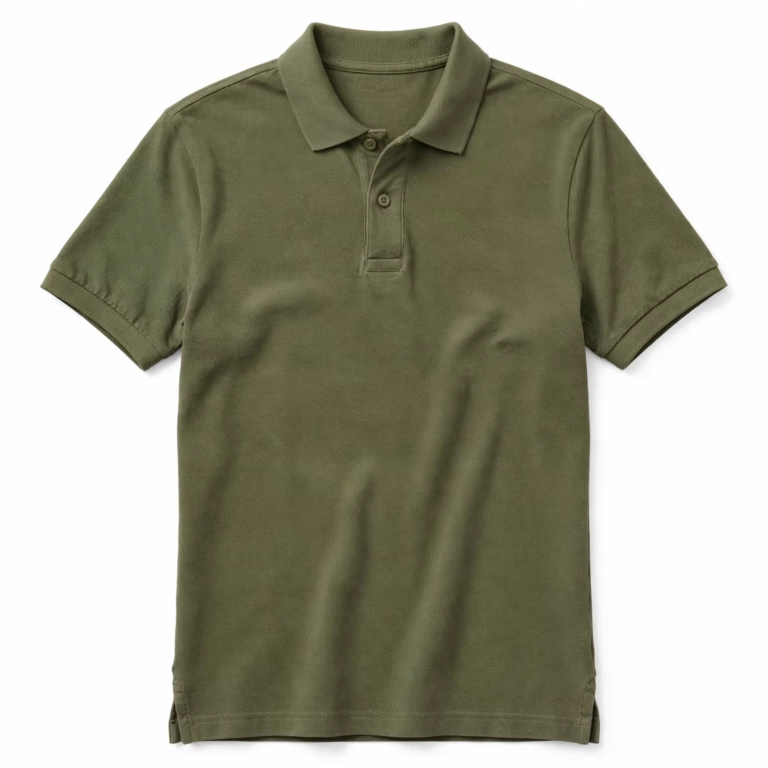
Custom Mens Light Grey Polo Shirt Manufacturer in Bangladesh for Melange Core Ranges
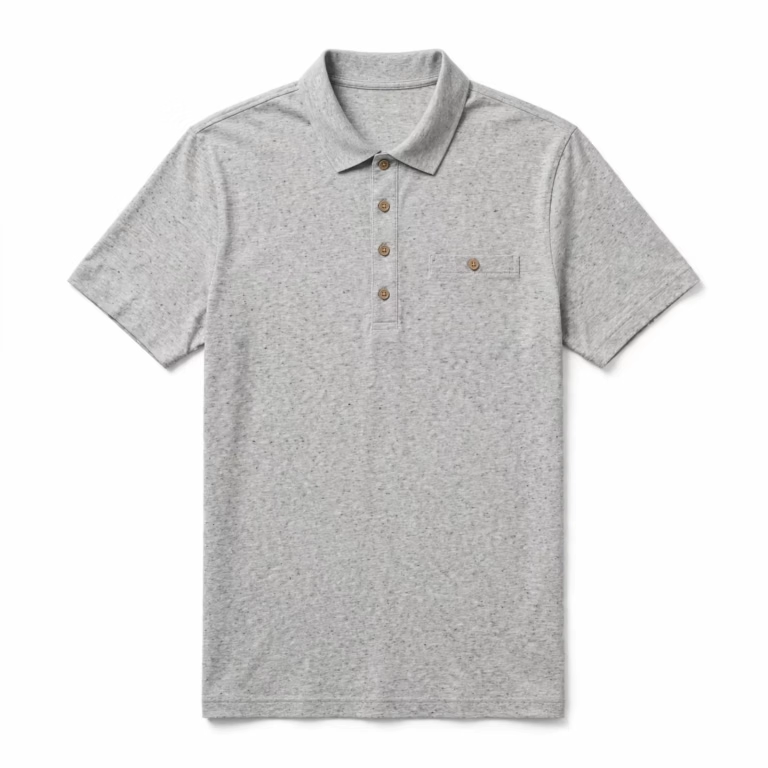
Grey melange is the hardest-working colour in any polo range, and this is its classic form: a light grey heathered polo with a long button placket, a small buttoned pocket and nothing else competing for attention.
Siatex makes it in Bangladesh for brands whose core programmes are built on exactly this kind of repeat-order staple. The melange balance, the button colour, the placket length and the grading all follow your specification.
A Light Grey Melange, Balanced
The colour is a light grey heathered melange: pale grey and white fibres blended inside the yarn with a fine speckled grain, even across body, collar, placket and sleeves. There are no panels and no contrast anywhere; the interest is in the yarn itself.
Melange balance is a specification, not an accident: too much dark fibre and the grey turns dirty, too little and it washes out. The blend is fixed at sampling, and bulk lots are checked against the approved swatch so reorders hold the same light, clean tone.
The Collar in the Same Melange
The collar is the classic folded polo collar in the same melange, with no tipping and no stripes. On a core-range polo that restraint is the point: the shirt has to sit inside a buyer’s colour story without arguing with it.
Collar shape and firmness are set at sampling. A melange collar shows sloppy setting at once, because the speckled surface betrays any twist, so the setting is checked on the first garment of every size.
A Long Placket, Four Tan Buttons
The placket runs long, to mid-chest, and fastens with four small round tan buttons. The extra length changes the shirt’s character: worn open it reads relaxed, worn closed it reads neat, and the tan against the grey is the one warm note in the design.
Placket length and button count follow your specification; a shorter three-button placket is cut from the same block. The tan button is sampled in a few tones, because half a shade either way changes how the grey reads.
A Small Pocket With Its Own Button
On the wearer’s left chest sits one small flat rectangular patch pocket, closed by a single small tan button at its top edge. It is a working detail sized for cards and small items, and it gives the plain front its one piece of structure.
Pocket size, position and button placement are fixed at sampling and held across sizes, so the pocket lands at the same point of the chest on every garment in the run, not only at the middle size.
Plain Hems on Short Sleeves
The sleeves are short and set in, ending above the elbow with plain narrow folded hems in the same melange. There is no ribbed band and no tipping: on this polo, the sleeve finish stays as quiet as the rest of the shirt.
That plainness is also practical for buyers: a folded hem takes a sleeve embroidery or a small print cleanly if a programme needs one, placed over a smooth melange surface that holds stitch work without puckering.
A Straight Hem, No Vents
The hem is straight across with no side vents, a clean finish that wears tucked or untucked without a tail escaping at the sides. The body is long, to hip level, so it stays tucked through a working day.
Hem depth and stitching follow your specification. On a melange garment the hem stitching is nearly invisible, which puts the quality burden on evenness: a wandering stitch line is the only fault a plain hem can show, and it is checked.
Slim-Regular, and Long Enough to Tuck
The fit is slim-to-regular with straight sides: neat through the chest, easy at the waist, and long enough in the body to wear either way. It is the middle fit that core ranges are built on, because it suits the widest spread of customers.
Each size is graded on your chart and the sample set is checked across the run. Your fit comments at sampling govern the final block, and the block is then frozen for reorders.
Nothing on the Back Either
The back is plain light grey melange with the folded collar above it and the straight hem below. There is no yoke detail, no back print and nothing to date the design from behind.
For uniform-adjacent and workwear programmes that plainness is a requirement, not a gap: the back is where a buyer’s own print or embroidery goes when the programme calls for it, over a clean melange ground.
The Label at the Collar Base
Inside the back neck, below the collar, your own woven label is sewn in your artwork. In our pictures it reads YOUR LABEL, because that space carries your brand and your care wording.
On a staple garment that sells for years, the label is the brand’s longest-lived asset on the product. Artwork, size marking and label placement are approved at sampling and held exactly across every reorder.
Fine Jersey, Not a Heavy Piqué
The cloth is a fine-grained heathered jersey with a lightly textured, speckled surface rather than a pronounced piqué waffle. It is matte, light to medium in weight, and softer against the skin than a heavy piqué, which suits long wearing days.
Weight and grain are confirmed at sampling against your target handle. Buyers who want the classic piqué texture instead can specify it on the same pattern; the block does not change.
Made in Bangladesh, Checked by Size
Production runs in our own Bangladesh lines, where melange polos are sewn daily: collars set without twist, plackets lying flat over four buttons, pockets placed by template, and a press that keeps the matte surface soft.
Bangladesh gives the order its depth of knit skill and its honest cost base. The first garment of every size is checked against the approved sample for melange tone, fit and finish before the run is packed.
Sampling a Core-Range Polo
Sampling starts from your melange reference, your cloth weight and your size chart. The first sample is checked for blend balance, placket lie and pocket placement, photographed, and sent for your approval.
Corrections are made and re-approved before bulk cutting starts. Buyers can stock this polo beside the other greys and colour stories in the same catalogue, building a core wall where each staple is sampled with the same discipline.
Companion Polos From the Same Line
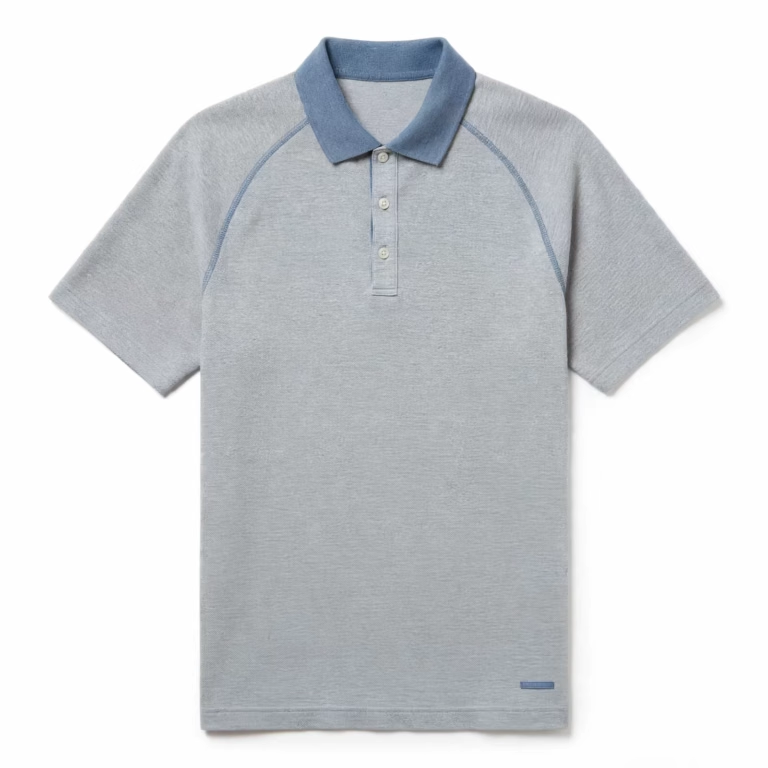
For the contrast-collar option, the Custom Men’s Grey with Blue Collar Polo Shirt pairs the melange with a dusty blue collar. The Custom Men’s Soft Tan Polo Shirt covers the warm neutral slot.
The Custom Men’s Soft Pink Polo Shirt brings the long placket in blush pink. Trade data for your target markets is published by the International Trade Centre.
What Buyers Ask About the Grey Melange
Buyers ask whether the melange tone drifts between production lots. The blend ratio is written into the order specification and checked against the stored swatch on every lot, so the grey that arrives in March matches the grey that arrived in October.
They also ask whether four buttons is too many for a polo. On this long placket the spacing is what makes it work: evenly set, the buttons read as a considered detail rather than a crowd, and the sample settles the question faster than any description.
Where a Grey Melange Polo Sells
Everywhere polos sell at all: staff programmes that need a neutral with texture, golf and leisure ranges, school-adjacent and club programmes, and retail core walls. Grey melange is the colour buyers choose when the garment must agree with logos, uniforms and other garments around it.
It is also the safest reorder in a catalogue, because nothing in it dates. A buyer building volume on repeat orders rather than seasonal stories is exactly who this polo serves.
Washing a Melange Jersey
The melange keeps its balance washed cool with similar colours; because the colour lives inside the yarn, there is no surface print to crack and no dye layer to fade unevenly. The fine grain stays readable wash after wash.
Care wording is yours to set on the label. The wash behaviour is confirmed on the approval sample, so the care instructions your customers read are the ones the garment was tested against. A cool wash and a low tumble keep the melange soft and the collar true, and the shirt asks for nothing more than that in ordinary weekly rotation.
Packing a Staple
Each polo is folded with the collar set and the placket buttons fastened, so the shirt arrives ready for the rail. Cartons follow your size ratios and markings, and mixed colourway orders across the polo catalogue are packed to your split.
On a staple, consistency is the presentation: the fiftieth shirt out of the carton should look like the first. The pack check is made against the approved sample before cartons close.
The Fleck Inside the Yarn
What separates a good melange from a flat grey is where the variation lives: inside the yarn, fibre by fibre, so the surface has depth at any distance. A printed or piece-dyed imitation reads flat by comparison, and customers feel the difference in the hand before they see it.
That depth is why melange photographs honestly and sells steadily. Our set is shot plainly, lit evenly, with the fleck at its true scale, so the page promises exactly what the carton delivers.
Tan Buttons, a Warm Note
The tan buttons do quiet work on this shirt: they warm the grey, give the placket its rhythm, and make the pocket button read as part of a set rather than an afterthought. Button material and tone are sampled in natural and dyed options, and the approved tone is recorded so replacements and reorders match.
A spare button in the same tan is sewn inside the side seam of every shirt. On a garment designed to be worn for years, that small provision is the difference between a repair and a retirement.
One Polo, Many Programmes
The same pattern serves very different buyers without changing a stitch: a workwear programme takes it plain, a leisure brand adds a small sleeve mark, a club takes its crest on the opposite chest. Because the base garment is neutral and proven, each programme starts from a sample that already fits and washes correctly.
That flexibility is the economic case for a staple done properly. Development cost is paid once, and the pattern then earns across every programme the buyer runs on it, season after season, without a single new fitting round or a fresh round of sampling risk for the buying team to manage.
Begin With the Sample
Send your size chart, your melange reference and your label artwork, and the first sample comes back for your approval before any bulk cutting. The pattern is proven, the cloth is light and clean, and the line is ready.
That is how Siatex works as your manufacturer in Bangladesh: your level, your quality, your fabric, your design and your measurements, sewn into a grey staple that reorders itself year after year. Reorders run from your approved sample and stored grading, so the tenth order matches the first at every size.